International Fluid Power Inc.
International Fluid Power - Innovative Partners For Global Sourcing Of Fluid Power Products. Your Complete Hydraulic Source in SE Minnesota.
Choosing the best China Furniture Side Drilling Cnc Machine starts with the work it must do, not a brochure photo. In cabinet production, a misplaced side hole can misalign a connector, slow assembly, and send a panel back to the operator. A suitable machine should drill repeatable horizontal holes, handle the panel sizes used in your shop, and fit your daily workflow.
The term Furniture Side Drilling Cnc Machine can describe different configurations, so compare actual capabilities carefully. Check spindle count and spacing, drilling depth, panel positioning, clamping method, software compatibility, and dust extraction. Ask for a sample run using your board material and drilling pattern. Watch how the machine references panel edges, holds narrow pieces, and performs repeated jobs. Small details matter.
Buying from a Chinese manufacturer can offer a broad choice of machine layouts and automation levels, but each supplier still needs careful evaluation. Request documented specifications, maintenance information, warranty terms, spare-parts availability, and a live demonstration. Confirm what installation and operator training include. A low quote is not proof of value. Neither is a polished video. Ask who will help if a setting fails during production.
This guide examines practical selection criteria, common trade-offs, and questions to ask before ordering. No machine is perfect. Even a capable model may require workflow adjustments, suitable tooling, and skilled setup. The right choice is the one that meets verified production needs consistently, with support your team can actually reach.
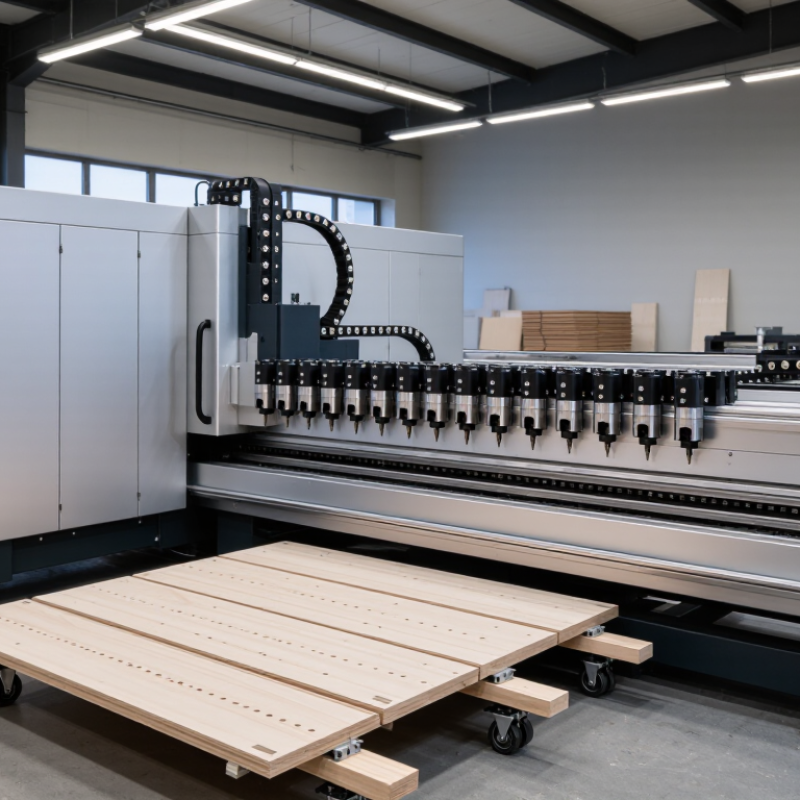
A furniture side drilling CNC machine drills horizontal holes into panel edges and selected faces. It follows digital coordinates to place holes for dowels, connectors, and shelf supports. Six-side capability means access to all six panel surfaces: the top, bottom, and four edges. In some configurations, the panel is processed in one clamping. That distinction matters. A machine may still require repositioning or flipping panels, so confirm what “six-side” means for its actual tooling and work cycle.
For a cabinet panel, the operator can program edge holes and face holes from the same job file. Sensors and stops help locate the panel, while clamps keep it steady during drilling. Small positioning errors can shift connector holes, so test a sample panel before running a full batch.
Check the usable panel size, drilling depth, tool layout, and software workflow against real production parts. A useful capability is not just a fast cycle. It must also reach the required hole positions without awkward handling. There is a catch: unusual panel shapes or closely spaced holes may need a different setup. A careful trial often reveals details that a specification sheet leaves out.
Best China Furniture Side Drilling CNC Machine?
Spindle count affects how many holes a machine can drill in one setup, but more spindles do not always mean higher output. Their spacing must match the furniture design, and the machine needs enough clearance for the panel and clamps. For repeated cabinet parts, a suitable spindle layout can reduce repositioning. For varied jobs, flexibility may matter more than spindle quantity. Small details matter.
Tooling shapes hole quality and daily consistency. Match drill diameter and length to the connector or fitting, then check that the tool is held securely. A worn drill can leave rough edges or wander, especially in laminated panels. Operators should test a sample piece before production and inspect both the entry and exit sides. The test may expose a setup issue you missed on screen.
Panel thickness also changes the required drilling depth, support, and clamping approach. Thin panels may flex under pressure; thicker panels need sufficient tool reach without sacrificing stability. Confirm the machine’s working range against the actual material, not just a typical project. Different core materials can behave differently, so results deserve a real trial.
Tips: Keep a record of tested tool settings and panel types. Recheck them after tool changes; one setting may not suit every board.
Chart: Relative through-drilling depth demand by panel thickness. The index is calculated from thickness relative to a 16 mm reference panel; it represents drilling depth, not measured cycle time or machine output.
More spindles can drill compatible holes in parallel, while suitable tooling can reduce tool changes. Actual productivity also depends on hole layout, material, feed settings, and machine limits, so compare machines using your own panel designs and production requirements.
A side-drilling CNC machine should be compared using measured results, not brochure claims alone. Check positioning accuracy in millimeters, and ask whether the figure refers to repeatability, absolute accuracy, or both. These are different measures. A stated tolerance of ±0.1 mm is useful only when the test method and workpiece conditions are clear.
Feed rate is usually listed in meters per minute, but maximum speed rarely tells the whole story. Ask for the cutting feed used on your actual board thickness and hole pattern. A faster traverse may save little if the machine must slow down for drilling, tool changes, or close hole spacing. Test a representative panel, then inspect hole positions with a suitable measuring tool. Small errors can affect fitting.
Cycle time should be reported in seconds per panel, with the start and finish points defined. Does the figure include loading, positioning, drilling, and unloading? Run several panels, not just one. Record the average and note interruptions or operator handling. A short test can look impressive. It may not reflect a full shift. I would still treat any single figure cautiously; real production varies with panel size, tooling, and setup.
A side-drilling CNC machine should be judged by measured performance, not a smooth demonstration. ISO 230-2:2014 provides methods for checking positioning accuracy and repeatability on numerically controlled axes. On a long panel, small positioning deviations can shift an entire row of dowel holes. Test across the machine’s working travel and in both directions, using a calibrated measurement system. Record temperature, approach direction, and results. Otherwise, precise-looking numbers may mislead.
ISO 13849-1:2023 addresses whether safety-related control parts meet the required risk-reduction level. Risk assessment determines the required performance level, or PLr; validation evidence should support the achieved level. On the shop floor, inspect guard switches, emergency stops, and spindle-stop behavior during controlled tests. A polished enclosure proves little. Check validation records and fault responses, not just component labels.
Deloitte’s 2025 Smart Manufacturing Survey reports that 92% of surveyed manufacturers expect smart manufacturing to drive competitiveness within three years. That is a survey expectation, not a machine-accuracy measure. When comparing Chinese side-drilling CNC machines, request positioning-test results and safety-validation evidence. One limitation deserves attention: factory setup conditions may differ from yours, so repeat critical checks after installation.
Choosing a side drilling CNC machine from China involves more than comparing purchase prices. Ask each manufacturer to drill your actual panel material, including its edges and finished surfaces. Check hole spacing with a measuring gauge, then inspect for tear-out and alignment errors. A smooth demonstration is useful, but repeatability matters more.
Service quality becomes visible after installation. Request a written commissioning plan, operator training hours, and realistic response times for remote support. Ask which common parts are stocked locally or can be shipped, and how long replacement usually takes. Get the answers in writing. A vague promise is not a service plan. Also, test the control interface yourself; a small workflow confusion can slow every shift.
Calculate total ownership cost over several years. Include tooling, maintenance, software fees, shipping, installation, power use, and expected downtime. Compare quotes using the same configuration, not just the same machine category. One point is easy to miss: the lowest-cost option may still fit a low-volume workshop best. That is not always a mistake. But if production grows, limited support or difficult programming may become expensive. Ask for customer references with similar workloads, and speak with an operator, not only a sales representative.
Use this neutral scorecard to compare supplier proposals. The weights are suggested evaluation priorities, not measured ratings of any specific manufacturer. Confirm all specifications, service commitments, and costs in writing.
| Category | Assessment factor | Suggested weight | What to verify | Evidence and scoring guide |
|---|---|---|---|---|
| Machine capability | Workpiece and hole compatibility | 10% | Confirm supported panel dimensions, thickness range, drilling directions, tool configuration, and compatibility with the intended furniture components. | Request a written specification sheet and a test using representative workpieces. Score higher when the demonstrated setup meets documented production requirements. |
| Machine capability | Accuracy and repeatability | 10% | Ask how positioning and drilling accuracy are specified, under what test conditions, and how results are measured. Check whether test reports identify the material and measurement method. | Compare documented test results against your own tolerance requirements; do not compare figures that use different test methods or conditions. |
| Production fit | Throughput and changeover | 10% | Request a timed demonstration using a representative job. Include loading, positioning, drilling, tool changes, and routine operator actions in the cycle-time discussion. | Use a witnessed demonstration or recorded test with clearly stated job details. Treat theoretical maximum speed separately from achieved production output. |
| Service | Installation and commissioning | 10% | Clarify what is included: delivery coordination, installation, leveling, calibration, operator training, acceptance testing, and travel or accommodation charges. | Score against a written scope, named responsibilities, schedule, and acceptance criteria. Identify any work or equipment the buyer must provide. |
| Service | Remote and onsite support | 10% | Ask for support hours, contact channels, response-time commitments, language coverage, troubleshooting process, and onsite service availability in your region. | Evaluate contractual service terms and escalation steps. A stated response time is not the same as a guaranteed repair or resolution time. |
| Service | Warranty and spare parts | 10% | Check warranty duration and start date, covered components, exclusions, labor and freight responsibility, parts availability, and the ordering process. | Use the written warranty and parts list. Request availability or lead-time information for critical wear items and components that could stop production. |
| Cost | Delivered and commissioned price | 10% | Separate machine price from packaging, inland transport, export handling, freight, insurance, import duties and taxes, installation, and training. | Compare quotations on the same delivery basis and scope. Confirm currency, payment milestones, quote validity, and any excluded charges. |
| Total ownership value | Operating and maintenance costs | 10% | Estimate electricity, consumables, routine maintenance, replacement tooling, software or service fees, and expected labor using your operating schedule. | Ask for consumption and maintenance assumptions. Use your local utility prices and actual planned production hours rather than relying on a generic estimate. |
| Total ownership value | Controls, software, and integration | 10% | Verify supported file formats, workflow compatibility, licensing terms, updates, backups, language options, and any required network or factory-system integration. | Request a practical file-to-machine test and written confirmation of included software functions, license limits, and future update costs. |
| Supplier risk | Documentation and delivery accountability | 10% | Review the final configuration, electrical requirements, safety documentation, delivery milestones, packing details, acceptance process, and remedies for nonconformity. | Score higher when requirements, responsibilities, and acceptance conditions are clearly documented in the quotation and purchase agreement. |
| Suggested total evaluation weight | 100% | Suggested weighted score: add each factor’s score out of 5 multiplied by its weight. Use the same evidence standard for every proposal. | ||
| Total cost of ownership framework | Purchase and delivery costs + installation and training + operating costs + maintenance and parts + software or service fees − estimated resale value. Set the same evaluation period and production assumptions for every machine being compared. | |||
This is an example of a widget area that you can place text to describe a product or service. You can also use other WordPress widgets such as recent posts, recent comments, a tag cloud or more.
© 2025 International Fluid Power, Inc. All Right Reserved.