What Are the Best Grinding Ball Types in 2026?
Choosing the best Grinding Ball in 2026 depends on the mill, ore, and operating conditions—not a single universal ranking. A ball that performs well in a high-impact circuit may wear too quickly in a fine-grinding application. Small differences matter. Feed size, slurry chemistry, mill speed, and liner design can all influence wear and energy use.
This guide compares common options, including forged steel, cast high-chrome, alloy steel, and ceramic grinding balls. It considers hardness, impact resistance, wear rate, contamination risk, and total operating cost. These factors help explain why a lower purchase price does not always mean a lower cost per tonne. A plant processing abrasive copper ore, for example, may prioritize wear life, while another operation may need greater impact resistance against coarse feed.
Supplier specifications provide a useful starting point, but they cannot replace operating evidence. Buyers should review test data from comparable mills, confirm material and size consistency, and, where practical, run controlled trials. Results can vary. Even a careful comparison has limits: ore characteristics and maintenance practices change over time, and published performance figures may reflect different conditions. The sections ahead offer a practical framework for assessing ball types, matching them to mill duties, and asking suppliers more precise questions. The aim is not to name one winner, but to identify a defensible choice for each application.
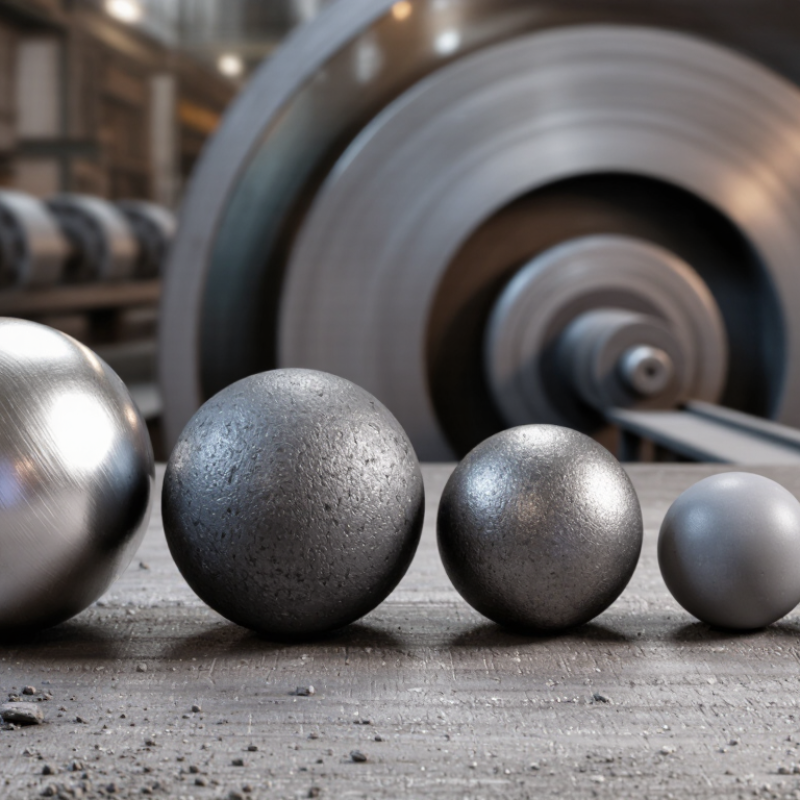
Grinding Ball Types in 2026: Forged Steel, Cast Steel, and Ceramic Media
The best grinding ball depends on ore hardness, mill speed, slurry chemistry, and contamination limits. Forged steel balls suit demanding impact conditions: their toughness can help resist breakage in coarse grinding. Cast steel offers flexibility in alloy and hardness, but casting quality and heat treatment matter. Inspect for uneven wear. Ceramic media, often alumina-based, resists corrosion and limits iron contamination. Its lower density can reduce impact energy, so it may not suit every high-throughput mill.
The U.S. Department of Energy’s 2007 Mining Industry Energy Bandwidth Study identifies grinding as roughly one-quarter of mining energy use. That makes media wear and mill performance more than purchasing details. The USGS Mineral Commodity Summaries 2025 estimates global cement production at about 4.1 billion metric tons in 2024, illustrating the scale of another major grinding application. These figures do not prove one media type is best. A plant should compare wear rate, power draw, product size, and contamination through controlled trials. Results can be messy: ore changes, and lab tests may not reproduce mill conditions. A practical choice is rarely perfect.
Ball Size Selection: Common Grinding-Media Diameters of 20–150 mm
Grinding-media diameters commonly range from 20 to 150 mm, but the largest ball is not automatically the best choice. Selection depends on feed size, ore hardness, mill dimensions, and the required product size. Larger balls deliver stronger impacts against coarse, tough material. Smaller balls provide more contact points for finer grinding. A mismatch can waste energy.
A practical starting point is to compare the largest feed particles with the mill’s operating conditions. Coarse feed may call for balls around 75–150 mm, while finer feed often benefits from 20–60 mm media. These ranges are guides, not fixed rules. A plant technician should review mill power, liner condition, and the size distribution of the ground material before changing the charge. Measure results.
Mixed ball sizes can support both coarse breakage and finer reduction. However, too many small balls may cushion impacts, while oversized media can leave fine particles under-ground. Watch the discharge, not just the feed. Trial changes in small steps, and record throughput, product size, and wear over several operating shifts. Results can be messy; ore hardness changes, and one test may mislead. That uncertainty deserves attention.
Material Standards: High-Chromium Cast Iron Under ASTM A532
High-chromium cast iron is often selected for grinding balls because its hard carbide structure helps resist abrasive wear. ASTM A532 provides specifications for abrasion-resistant cast irons, including different grades and heat-treatment requirements. The standard is a starting point, not a promise of identical performance in every mill.
When reviewing a ball’s material, check the stated A532 class and type, chemical analysis, heat-treatment records, and measured hardness. These details help confirm what was supplied.
Hardness alone is not enough. The carbide distribution and matrix also affect wear and the risk of cracking under impact. Details matter.
Operating conditions can change the result. Ore hardness, mill speed, ball size, and impact levels all influence service life. A high-chromium grade may perform well in abrasive conditions, yet prove less suitable where impacts are severe. That trade-off deserves attention.
A certificate may look complete, but it does not show how consistently the balls were cast or heat-treated. Ask for batch-specific test results and inspect samples when possible. Even then, test data cannot replace a controlled mill trial; that is an imperfect, but useful, check.
Mill-Speed Compatibility: Typical Operation at 65–75% of Critical Speed
What Are the Best Grinding Ball Types in 2026?
At 65–75% of critical speed, a conventional tumbling mill often provides a practical balance between cascading and cataracting. Balls lift with the rotating shell, then fall through the ore. The motion creates grinding action without keeping every ball pinned against the liner. It is a useful operating range, not a universal setting.
Ball material and size still matter. Forged steel balls can suit duties with repeated impact, while cast alloy balls may be selected for particular wear conditions. Ceramic media can help where metal contamination is a concern, but it may not tolerate every high-impact application. Match media to the ore, mill, and required product size. Speed alone cannot identify the best type.
Small adjustments make a difference. Near 65%, a mill may favor more cascading and attrition; toward 75%, impacts can become stronger, depending on liner shape and charge level. Listen for unusual impacts, inspect wear patterns, and compare power draw with product size. Still, this tidy range can mislead. Ore hardness, feed size, and liner condition can shift the useful setting. Trial data is imperfect, but it is better than assuming one speed fits every circuit.
What Are the Best Grinding Ball Types in 2026? — Mill-Speed Compatibility: Typical Operation at 65–75% of Critical Speed
| Grinding-ball type | Indicative density (g/cm³) | Common applications | Typical characteristics | Mill-speed compatibility |
| Forged steel | About 7.8 | Mineral processing and other applications needing robust impact grinding | High density and impact toughness; performance depends on steel grade, heat treatment, and operating conditions. | Typical starting range: 65–75% of critical speed.
This range applies broadly across ball materials; ball composition alone does not set the mill speed. Actual operating speed depends on mill design, liners, charge, and grinding duty. |
| High-chromium cast iron | About 7.5–7.8 | Abrasion-intensive grinding where wear resistance is a priority | High hardness and wear resistance; suitability depends on impact severity and the specific alloy and heat treatment. |
| High-alumina ceramic | About 3.6–3.9 | Fine grinding and processes where iron contamination should be limited | Lower density than steel; can reduce iron pickup, but impact energy and suitability depend on the mill and feed. |
| Zirconia ceramic | About 5.7–6.1 | Fine or high-purity grinding in specialized applications | Denser than alumina ceramic and suited to contamination-sensitive duties; selection should account for cost and process requirements. |
| Silica pebbles | About 2.6–2.7 | Some non-metallic grinding duties where low iron contamination is important | Lower density than steel or engineered ceramics; check grinding efficiency, pebble wear, and process compatibility. |
Speed note: Critical speed is the approximate rotational speed at which grinding media begin to centrifuge against the mill shell. A commonly used estimate is Nc ≈ 42.3 / √(D − d) rpm, where mill inside diameter D and ball diameter d are in metres. The 65–75% range is a typical operating guideline, not a universal set point; confirm the appropriate speed for the specific mill and duty. Density values are indicative and vary by material formulation.
Wear and Cost Evaluation: Compare Hardness (HRC) and Consumption (g/t)
What Are the Best Grinding Ball Types in 2026?
Hardness is useful, but it does not predict cost by itself. ASTM A532/A532M lists hardness requirements for abrasion-resistant cast irons; actual ball grades and heat treatments differ. In plant specifications, forged steel balls commonly sit around 58–66 HRC, while high-chrome cast balls are often specified near 60–66 HRC. Treat these as indicative ranges, not a direct ranking. A harder ball may resist flattening, yet brittle media can chip when feed size or impact loads are high. The SME Mineral Processing and Extractive Metallurgy Handbook also emphasizes that ore properties and circuit conditions shape wear. Small details matter: inspect broken balls, liner marks, and the discharge screen.
Track consumption in grams per tonne, using weighed additions and mill throughput over the same period. A broad operating screen of roughly 200–1,000 g/t appears across mill conditions, but it is not a universal target; ore abrasiveness, ball size, and grind size can shift the result sharply. Compare cost per tonne at the same product size, not just purchase price or HRC. For example, a 10% reduction in g/t may still lose value if harder media raise power use or leave coarse fragments. That comparison needs better data than one week of logs. Seasonal ore changes can distort it. Check the ASTM hardness method, then run a controlled trial and record both HRC and g/t.
