Best Fence Machine Manufacturer in China?
Choosing the best Fence Machine manufacturer in China requires more than comparing prices or polished product photos. A reliable decision starts with the actual job: fence type, wire diameter, mesh size, output target, and available factory space. Small details matter. A sample panel, for example, can reveal uneven welds or inconsistent spacing before a full production run begins.
W. Edwards Deming’s manufacturing principle, “Quality is everyone’s responsibility,” offers a useful lens for evaluating equipment suppliers. It is not a fence-machine-specific statement, but it applies directly to production quality. Ask how the manufacturer checks welding consistency, tests machine settings, and records inspections before shipment. Request a live demonstration using material close to your own. Listen for stable operation, not just a high advertised speed. Ask about setup guidance, spare parts, and response times, too. These answers help show whether support continues after delivery.
There is no universal winner. A supplier suited to a large factory may not fit a smaller workshop with limited floor space or a different product mix. Compare technical specifications, sample quality, communication, and service commitments side by side. Then verify important claims in writing. One point is easy to overlook: even good machinery needs proper setup and trained operators. I would not treat a confident sales pitch as proof. The strongest choice is the manufacturer whose equipment matches your real production needs, and whose evidence holds up when you ask careful questions.
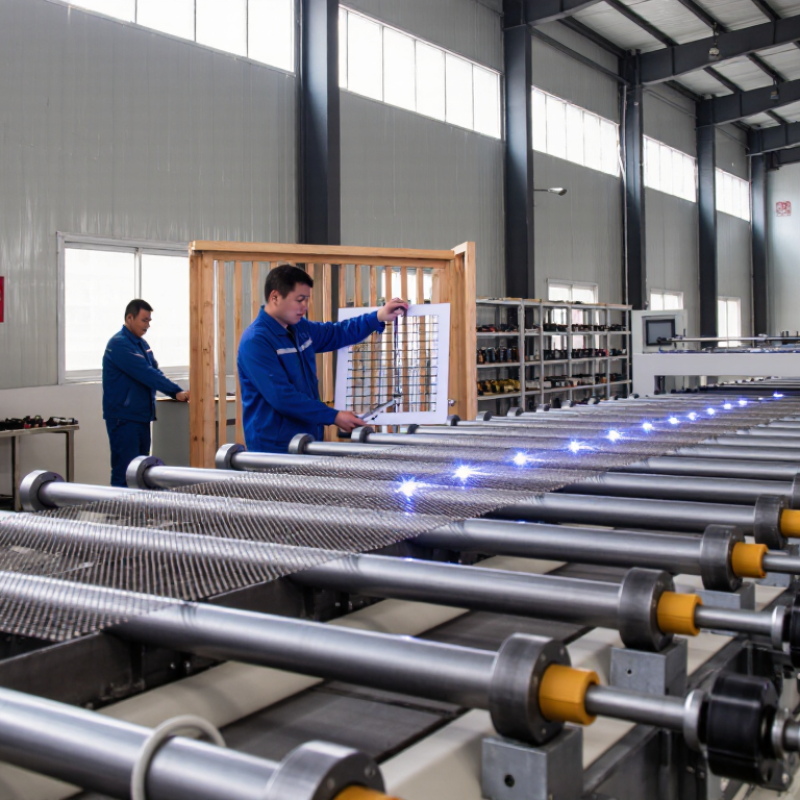
Fence-Making Machines: Types, Applications, and Production Metrics
Fence-making machines serve different production needs. A chain-link line twists and winds wire into rolls for farms, sports grounds, and site boundaries. Welded-mesh equipment joins crossing wires at fixed intervals, producing panels for building enclosures and animal housing. Other systems straighten and cut wire, form fence posts, or bend finished panels. Each process needs suitable wire diameter, mesh opening, and feed control.
Useful production metrics include output per hour, changeover time, scrap rate, and machine uptime. A line may produce many meters per shift, but that figure can mislead if operators must stop often to clear wire jams. Measure finished, quality-checked output instead.
Track sample panels for consistent openings and sound welds. Small details matter. A loose guide can shift the mesh; worn electrodes may weaken joints.
When comparing equipment, ask for a production trial using the intended wire and product dimensions. Check how quickly settings can be adjusted between orders, and confirm that guards, sensors, and routine maintenance points are accessible. Record energy use and staffing needs alongside speed. Numbers need context. A modest line with steady output may suit a small workshop better than a faster system that requires frequent adjustment. One limitation is that trial conditions rarely match every shift, so production estimates should leave room for material variation and operator learning.
How Wire Feeding, Welding, Weaving, and Coiling Shape Fence Output
Fence output starts with controlled wire feeding. Pay-off stands, straighteners, and tension rollers must deliver wire evenly. If the wire jerks or bends, mesh spacing can drift before production speeds up. Small errors travel. Operators often check wire diameter, feed alignment, and roller wear at the start of a shift, then adjust as the wire changes.
Welding and weaving shape different fence products. In a welded-mesh line, electrodes need steady pressure and current to create consistent intersections. A sample panel can reveal weak welds, burn marks, or uneven openings. Woven fence depends more on wire tension and forming tools. Loose tension may leave slack; excessive tension can distort the pattern. The two processes need different machine setups, even when both use similar wire.
Coiling affects handling and installation. A take-up unit should form compact rolls without crushing the outer layers or letting the coil loosen. Check roll edges, weight, and winding direction against the buyer’s requirements. Real production is not perfectly steady. Wire batches vary, and operators sometimes need to correct the setup mid-run. A manufacturer’s practical knowledge shows in clear adjustment guidance, accessible wear parts, and test runs using the intended wire—not just in a machine’s advertised speed.
Key Specifications: Wire Diameter, Mesh Pitch, Line Speed, and Capacity
Best Fence Machine Manufacturer in China?
Key Specifications: Wire Diameter, Mesh Pitch, Line Speed, and Capacity
Choosing a fence machine starts with the wire you actually plan to run. Check its supported diameter range, not just the maximum value on a specification sheet. A machine designed for thin wire may struggle with thicker stock or frequent changes. Mesh pitch matters too. Confirm both the minimum and maximum spacing, then test a sample panel for consistent intersections. Small variations can affect fit during installation.
Tips: Ask for a trial using your wire and target mesh size. Watch the feed, weld points, and finished panel edges. A short demonstration helps, but it cannot prove long-term reliability.
Line speed is useful only when paired with stable output. Ask how many finished panels the machine can produce per shift under your operating conditions. Clarify whether the stated capacity includes setup time, wire loading, and routine adjustments. These details are easy to miss. I would also check how operators change pitch and clear a jam; a fast machine can lose its advantage when adjustments take too long. Request maintenance intervals, spare-part lead times, and a clear acceptance test before comparing manufacturers. A polished quotation is not the whole story. The best fit depends on your product mix, available floor space, and crew experience.
Best Fence Machine Manufacturer in China? Key Specifications: Wire Diameter, Mesh Pitch, Line Speed, and Capacity
Compare representative welded-mesh operating profiles. The chart shows estimated gross area output, not a guaranteed production rate.
| Operating profile | Wire diameter | Mesh pitch | Line speed | Estimated gross output |
| Light mesh | 3–4 mm | 100–200 mm | 10 m/min | 1,500 m²/h |
| General-purpose mesh | 4–5 mm | 75–150 mm | 8 m/min | 1,200 m²/h |
| Heavy mesh | 5–6 mm | 50–100 mm | 5 m/min | 750 m²/h |
Estimates use a constant 2.5 m working width and the formula: width × line speed × 60. They represent theoretical gross output before downtime, changeovers, or rejected product. Confirm achievable wire diameter, pitch, and speed with the machine supplier for your specific product.
ASTM A392 Benchmarks: Zinc Coatings of 366 or 610 g/m²
Best Fence Machine Manufacturer in China? ASTM A392 Benchmarks: Zinc Coatings of 366 or 610 g/m²
For galvanized chain-link fabric, ASTM A392 sets two familiar zinc-coating benchmarks: 366 g/m² and 610 g/m². These correspond to 1.2 and 2.0 ounces per square foot. The higher coating mass provides more zinc, but it does not guarantee a fixed service life. Wire diameter, coating uniformity, handling damage, and local exposure all matter. Small details count.
A fence machine manufacturer should be able to control wire feeding, mesh formation, and production consistency without scraping or flattening the coating. Ask for coating-mass test records, not just a catalogue claim. ASTM A392 provides the specification; a calibrated weighing or stripping test can help verify actual production. Measure, don’t assume. Even a good test may miss uneven coating across a large batch.
Exposure changes the equation. The American Galvanizers Association’s published atmospheric corrosion data shows zinc loss can be around 0.1–0.2 μm per year in rural settings, while harsher marine or industrial conditions can cause losses of several micrometers annually. These are environmental estimates, not a promise for any fence. A practical supplier discussion should cover the intended site, target coating class, and inspection method. I would also request sample wire from a normal production run; polished demonstrations can hide ordinary variation.
How to Evaluate Chinese Manufacturers: Quality Systems, Service, and ROI
Best Fence Machine Manufacturer in China?
A reliable evaluation starts with evidence, not a polished brochure. Ask how the manufacturer controls frame welding, electrical assembly, and final machine testing. Request sample inspection records and clear acceptance criteria. For a mesh welding line, check wire-feed consistency and weld spacing across several test panels. Small details matter. A clean workshop is encouraging, but it does not prove every machine performs consistently. Verify the process.
Service affects production as much as machine quality. Ask who handles installation, operator training, and fault diagnosis after delivery. Confirm which spare parts are stocked and how quickly technical support typically responds. Request a sample maintenance schedule. Compare the full operating cost, including energy use, tooling, downtime, and setup changes—not only the purchase price. A lower quote may look attractive; frequent stoppages can quietly erase the savings. Still, estimates are imperfect, and your own production mix may change the result.
Tips: Request a live trial using your wire specifications. Check several finished panels, not just one. Ask for a written list of included parts and service. Speak with a current customer if possible, while remembering that one factory’s experience may not match yours.
