INTERNATIONAL FLUID POWER, INC.

The Experts for Hydraulic Power Units, Components, and Custom Hydraulic Systems
Slider

How to Choose the Right Air Heat Exchanger?

Choosing the right Air Heat Exchanger affects energy use, indoor comfort, equipment life, and maintenance costs. The decision should begin with actual operating conditions, not a catalogue photograph. Airflow, temperature difference, humidity, pressure drop, and available installation space all matter. A unit sized for 10,000 cubic meters per hour may perform poorly when filters become dirty or outdoor temperatures rise.

Real facilities rarely operate in perfect conditions. Dust may collect on fins. Fans may run longer than expected. A compact exchanger can save space, yet create higher resistance and increase electrical demand. Materials also deserve careful attention. Coated aluminum may suit a humid environment, while stainless steel could provide better durability in corrosive air. The choice depends on exposure, cleaning practices, and the required service life.

Reliable selection combines engineering calculations, manufacturer data, field experience, and applicable testing standards. Heat recovery efficiency should be checked alongside leakage, noise, frost risk, and controllability. A vendor’s headline efficiency is useful, but it may not reflect winter operation or fouled surfaces. That detail is easy to miss.

No selection is perfect. A clean spreadsheet can still hide an unrealistic assumption. Comparing several verified proposals helps expose those weaknesses. This guide explains how to match exchanger design with thermal loads, airflow requirements, building conditions, maintenance resources, and long-term operating goals. The result should be measurable performance, practical upkeep, and fewer expensive surprises after installation.
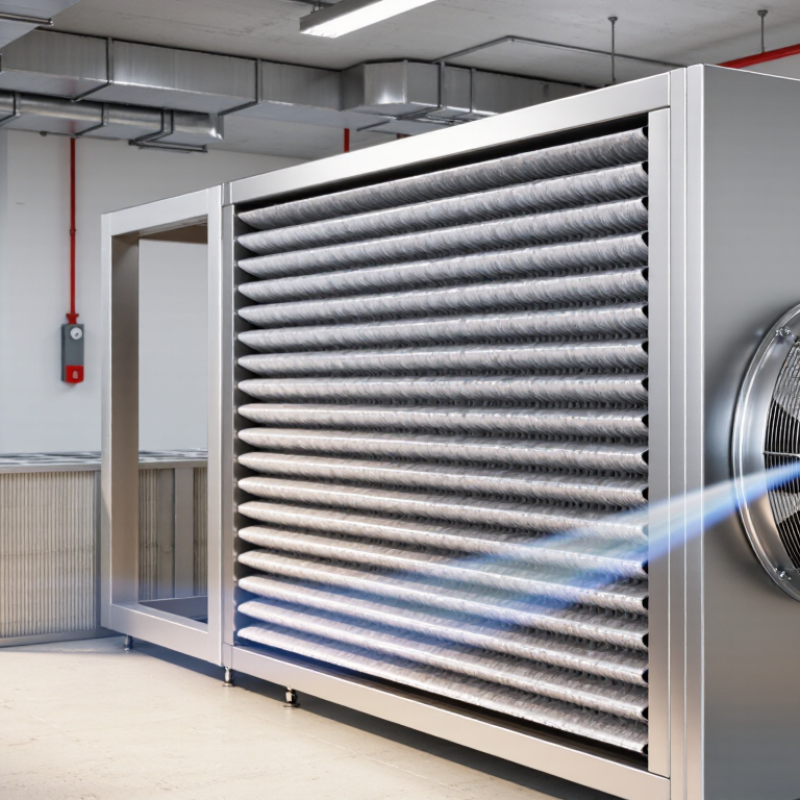
How to Choose the Right Air Heat Exchanger?

Types of Air Heat Exchangers and Their Main Applications

How to Choose the Right Air Heat Exchanger?

Types of Air Heat Exchangers and Their Main Applications

Air heat exchangers move heat between air streams or between air and another fluid. The best type depends on temperature, airflow, humidity, pressure, and maintenance access.

Plate-fin exchangers use layered metal plates to create separate air channels. They suit ventilation systems, process cooling, and compact equipment. Their simple structure supports reliable operation, but narrow passages may clog in dusty environments.

Rotary heat wheels transfer sensible heat between supply and exhaust air. They work well in offices, hospitals, factories, and large ventilation systems. Some models can also transfer moisture. However, wheel sealing needs regular inspection because leakage can reduce indoor air quality.

Fixed-plate exchangers avoid rotating parts and cross-contamination risks. They are practical for homes, laboratories, and clean production areas. Condensation may freeze in cold weather, so drainage and frost protection matter.

Heat pipe exchangers use sealed pipes to move heat without fans or pumps. They fit areas with limited maintenance access, such as data rooms and air-handling units. Air-to-liquid coils are more suitable when air must be heated or cooled by water, glycol, or refrigerant.

Measure real airflow, not only the fan rating. Filters, bends, and seasonal dirt can change performance. A selection that looks efficient on paper may disappoint in service. Testing noise, pressure drop, and temperature recovery before final installation is often worthwhile.

Key Performance Factors for Comparing Air Heat Exchangers

Choosing an air heat exchanger starts with measurable performance, not catalogue appearance. The U.S. Department of Energy reports that many energy recovery ventilators recover approximately 70–80% of energy from exhaust air. However, this figure depends on airflow, temperature difference, and operating conditions. Compare sensible effectiveness for temperature control and latent effectiveness when humidity matters. A unit rated at 80% effectiveness may perform differently at low airflow or during winter frost conditions. Test conditions matter greatly.

Pressure drop deserves equal attention. Higher resistance increases fan energy and may reduce delivered airflow. ASHRAE guidance identifies airflow rate, face velocity, leakage, and pressure loss as critical selection factors. Check certified data tested under recognized procedures, such as AHRI Standard 1060. Also examine cross-leakage, especially where exhaust air contains odors or contaminants. Small details matter. Filter loading can change performance.

Field selection often exposes a weakness in simple comparisons: thermal efficiency gets attention, while maintenance receives less. Inspect access panels, drain arrangements, frost protection, and sensor accuracy. The IEA’s Buildings 2023 analysis shows that buildings remain responsible for about 30% of global energy demand, so inefficient fans should not be ignored. A lower-cost exchanger can create higher lifetime costs through cleaning, replacement, and electricity use. There is no perfect rating. Recheck assumptions against local climate, operating schedules, and actual duct resistance before approving the final model.

How to Choose the Right Air Heat Exchanger?

Key performance factors for comparing common air-to-air heat exchanger configurations.

How to read the chart: Heat recovery effectiveness indicates the percentage of sensible heat transferred between air streams. Pressure drop shows the approximate airflow resistance at the design point; lower pressure drop generally reduces fan energy consumption. Actual performance depends on airflow rate, temperature difference, humidity, exchanger size, fouling, and installation conditions.

How to Calculate Heating and Cooling Requirements

How to Choose the Right Air Heat Exchanger?

Heating and cooling calculations should begin with the room, not the exchanger catalogue. Measure indoor and outdoor temperatures during the design season. Record humidity, airflow, occupancy, lighting, equipment, and fresh-air requirements. These details shape the actual load.

For sensible heat, use Q = 1.2 × airflow × temperature difference. Here, Q is measured in watts when airflow is in cubic metres per second. Add transmission losses through walls, roofs, windows, and doors. Include heat from people and equipment during cooling. Moisture also matters. In humid spaces, calculate latent cooling load separately. A sensible-only estimate may undersize the system.

Peak conditions matter most. An average daily temperature can hide a difficult afternoon. Select an exchanger using its rated airflow, temperature effectiveness, pressure drop, and recovery performance. For heating, estimate recovered heat with Qr = airflow × air density × specific heat × temperature rise. Then subtract this value from the heating demand. Cooling calculations require the same approach, while considering recovered moisture when applicable. Keep a safety margin, but do not make it excessive. An oversized unit may cycle poorly and waste fan energy. A tidy spreadsheet can still mislead. Recheck assumptions against measured readings after installation. That step often reveals unexpected leakage, dirty filters, or lower airflow than planned.

Selecting Materials, Size, and Configuration

How to Choose the Right Air Heat Exchanger?

Selecting an air heat exchanger starts with the operating environment. In practical installations, material choice often decides service life before performance becomes visible. Carbon steel can suit dry, controlled air, while stainless steel handles moisture and corrosive conditions more reliably. Aluminum offers low weight and strong thermal conductivity, but it may require protection in aggressive atmospheres. Check temperature, humidity, chemical exposure, and cleaning methods together. A material that looks economical can become expensive after repeated repairs.

Sizing needs more than airflow alone. Calculate air volume, inlet and outlet temperatures, allowable pressure drop, altitude, and expected fouling. Undersizing creates weak heat recovery. Oversizing may waste space and energy. Configuration also matters. Counterflow arrangements usually provide stronger temperature transfer, while crossflow designs can simplify installation. Consider fin spacing, maintenance access, condensate drainage, fan location, and noise. A neat spreadsheet can still miss seasonal changes. Recheck assumptions with measured operating data whenever possible.

Tips: Request certified performance data, not only catalogue capacity. Leave room for filter cleaning and coil inspection. Choose wider fin spacing where dust is heavy. Review pressure loss at both clean and dirty conditions. If the system handles condensation, add a proper drain and slope. Small details matter.

How to Choose the Right Air Heat Exchanger? - Selecting Materials, Size, and Configuration

Selection Factor Typical Options or Range Recommended Application Key Selection Guidance
Heat Exchanger Type Plate, rotary wheel, heat pipe, or run-around coil Choose according to allowable cross-contamination, installation space, and maintenance requirements Plate units have no moving parts; rotary units generally provide high recovery with a compact footprint; heat pipes require suitable orientation; run-around coils allow separated air streams.
Heat Recovery Performance Sensible effectiveness commonly about 50%–85%, depending on design and operating conditions Ventilation systems, process exhaust recovery, and energy-efficient air handling Compare products at the same airflow, entering temperatures, humidity conditions, face velocity, and pressure drop. Effectiveness alone does not determine total operating cost.
Primary Heat-Transfer Material Aluminum; stainless steel; coated or galvanized steel Material choice should match humidity, contaminants, temperature, and cleaning method Aluminum offers low weight and good thermal conductivity. Stainless steel is preferable for corrosive, hygienic, or high-temperature service. Coated or galvanized steel may suit less aggressive environments.
Corrosion Exposure Low, moderate, coastal, chemical, or high-humidity environment Industrial exhaust, marine locations, wastewater areas, kitchens, and humid climates Specify corrosion-resistant surfaces, suitable coatings, drainable geometry, and inspection access. Confirm compatibility with chlorides, acids, solvents, and cleaning chemicals.
Airflow Capacity Determine from required ventilation or process airflow, typically expressed in m³/h or CFM All air-to-air heat exchanger applications Select the exchanger for the actual design airflow and include reasonable allowance for filter loading, fouling, altitude, and future capacity needs.
Face Velocity Approximately 1.5–3.0 m/s for many ventilation applications General ventilation where balanced efficiency, size, noise, and pressure drop are required Lower velocity usually reduces pressure drop and noise but increases core size. Higher velocity can reduce equipment size while increasing pressure drop and potential carryover.
Core Face Area Face area = Airflow ÷ (3600 × Face velocity), when airflow is in m³/h Preliminary sizing of the heat exchanger face Example: 5,000 m³/h at 2.5 m/s requires approximately 0.56 m² of face area before considering casing, bypass, and service clearances.
Illustrative Core Dimensions 1,000 m³/h: about 0.11 m²; 5,000 m³/h: about 0.56 m²; 10,000 m³/h: about 1.11 m² at 2.5 m/s Early-stage layout and equipment-room planning These are calculated face areas, not final product dimensions. Confirm core width, height, depth, casing, access panels, filters, dampers, and duct transitions with the final selection.
Core Depth Commonly selected in the approximate range of 200–600 mm, depending on construction Applications requiring a balance between effectiveness and available installation depth Greater depth can increase heat-transfer area and effectiveness, but may also increase pressure drop, weight, cost, and cleaning difficulty.
Fin or Plate Spacing Approximately 2–6 mm for many compact air-side designs Spacing should reflect air cleanliness, moisture, and fouling risk Tighter spacing provides more heat-transfer surface but is more sensitive to dust and blockage. Wider spacing improves cleanability and is better for dirty or lint-laden air.
Pressure Drop Often designed within approximately 100–300 Pa per air stream, subject to the system design Energy-conscious HVAC and ventilation systems Use the manufacturer’s certified performance data. A lower initial purchase price may result in higher fan energy costs if the exchanger has excessive resistance.
Air Leakage and Cross-Contamination Low-leakage plate design, purge-sector rotary design, or separated-loop configuration Hospitals, laboratories, kitchens, toilets, and contaminant-sensitive processes Avoid direct air-to-air transfer when exhaust contaminants cannot be tolerated. Specify sealing quality, pressure relationships, purge arrangements, and leakage limits.
Condensation and Frost Control Drain pan, condensate connection, bypass, preheat, defrost cycle, or frost-resistant control strategy Cold climates and systems with humid exhaust air Check dew-point and frost conditions at the coldest design temperature. Provide drainage and access for cleaning where condensation is expected.
Temperature Range Select according to minimum and maximum entering-air temperatures and any process temperature peaks Commercial ventilation, industrial exhaust, and heat-recovery systems Verify material limits, seal compatibility, coating temperature rating, thermal expansion, and any fire or smoke requirements.
Configuration Counterflow, crossflow, or cross-counterflow Configuration should match required effectiveness and available duct arrangement Counterflow generally offers high thermal effectiveness. Crossflow is often easier to integrate into compact equipment. Cross-counterflow provides a compromise between performance and layout flexibility.
Maintenance and Cleaning Removable core, inspection doors, washable surfaces, drain access, and replaceable seals Dusty, greasy, humid, or hygiene-controlled environments Allow enough clearance for inspection and removal. Include upstream filtration and select spacing that will not clog under the expected contaminant load.
Final Verification Data Airflow, entering temperatures, humidity, effectiveness, pressure drop, leakage, sound, dimensions, and weight Final equipment specification and procurement Do not finalize the selection from nominal airflow alone. Confirm certified performance at the exact operating point and verify compliance with applicable local codes and project requirements.
Note: The numerical ranges are typical preliminary-design values. Final sizing and material selection should be based on project-specific airflow, temperature, humidity, contaminant, pressure-drop, maintenance, and regulatory requirements.

Installation, Maintenance, and Energy Efficiency Considerations

Choosing the right air heat exchanger starts with the building’s airflow, climate, and operating schedule. A unit that performs well in a laboratory may struggle in a dusty workshop. Select sensible or enthalpy recovery based on humidity control needs. Check airflow balance, pressure drop, frost protection, and access for cleaning. Poorly sized fans can erase expected energy savings.

Installation details matter. Keep outdoor-air intakes away from exhaust outlets, loading areas, and standing water. Insulate ducts through unconditioned spaces. Seal joints carefully; small leaks can reduce recovered heat before it reaches occupied rooms. The U.S. Department of Energy reports that many heat-recovery ventilators can recover about 70–80% of energy from outgoing air. That figure depends on commissioning, filters, and actual weather. It is not a guarantee.

Tips: Measure airflow after installation, not only during design. Record fan power, supply temperature, and filter pressure every month. Clean cores and drain pans according to site conditions. Replace damaged seals immediately. The International Energy Agency reports that buildings consume roughly 30% of global final energy, so maintenance has a meaningful role. Still, energy efficiency should not override indoor-air quality. A tighter system may expose ventilation weaknesses. Recheck comfort complaints, humidity, and carbon dioxide levels seasonally. The best choice is sometimes less efficient on paper, but easier to inspect and maintain.