International Fluid Power Inc.
International Fluid Power - Innovative Partners For Global Sourcing Of Fluid Power Products. Your Complete Hydraulic Source in SE Minnesota.
Choosing a Pos Machine Battery in 2026 requires more than comparing milliamp-hours. Payment terminals are becoming busier, more connected, and less tolerant of unexpected downtime. Worldpay’s Global Payments Report 2024 found that digital wallets represented about 50% of global e-commerce value and 30% of point-of-sale spending in 2023. That shift increases the need for reliable terminals during long queues, outdoor events, and mobile checkout.
Battery specialist Dr. Isidor Buchmann, founder of Cadex Electronics, has written, “The battery is the most delicate part of a portable device.” His warning remains practical. Heat, frequent charging, deep discharge, and poor storage can shorten service life. A high-capacity pack may still disappoint if its connector, protection circuit, or charging profile does not match the terminal.
This guide examines lithium-ion and lithium-polymer options, rated voltage, usable capacity, cycle life, recharge time, operating temperature, and physical fit. It also considers safety evidence, including IEC 62133-2 testing and UN 38.3 transport requirements. The right Pos Machine Battery should support a full working shift without creating excessive weight or charging delays. Measure the original pack carefully. Check the terminal manufacturer’s specifications. Confirm replacement compatibility before ordering.
No checklist is perfect. Real usage often differs from laboratory ratings. A battery advertised for ten hours may provide less under constant Bluetooth, Wi-Fi, receipt printing, and bright-screen use. That gap matters. In 2026, the best choice will balance endurance, safety, availability, and long-term replacement cost—not simply the largest number on the label.
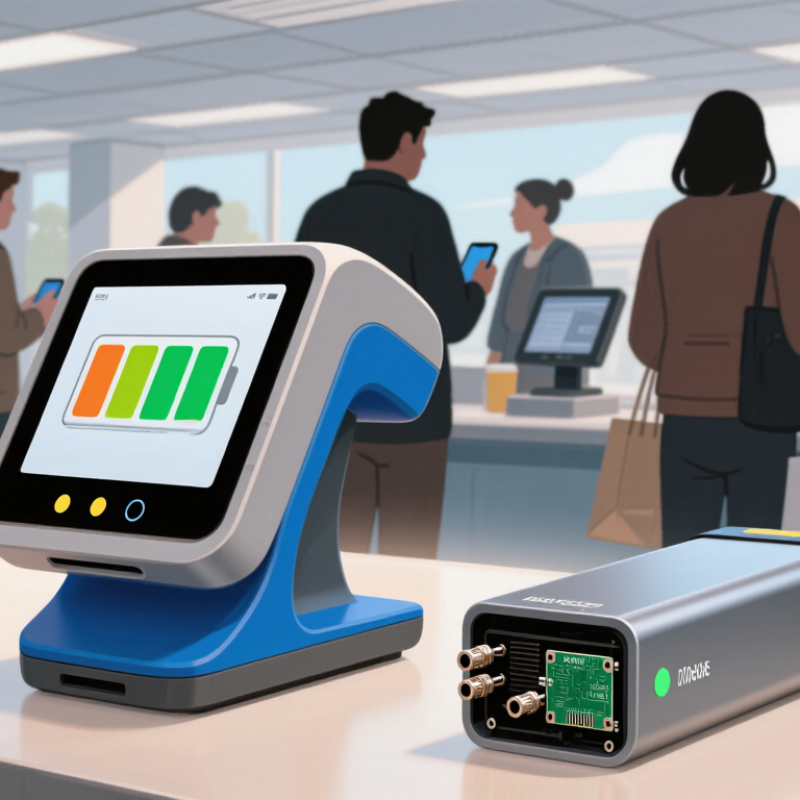
A POS machine battery stores energy for payment terminals used at counters, stalls, and mobile checkout points. It keeps the screen, processor, card reader, and wireless connection working when no outlet is nearby. Without stable power, a transaction may stop halfway. That creates delays, repeated payments, and frustrated customers. Small battery details matter.
Capacity is important, but capacity alone can mislead. A higher mAh rating does not always mean longer service. The machine’s voltage, display brightness, network use, and software load also affect runtime. Check the original voltage range and connector before choosing a replacement. A qualified technician should verify compatibility. Guessing is risky.
Look for a battery with dependable cycle life, controlled heat, and protection against overcharging and deep discharge. Lithium-based batteries are common, but their quality varies widely. A reliable unit should include clear electrical specifications and traceable safety testing. In busy shops, measure how long the terminal actually runs during peak hours. Laboratory figures can feel optimistic.
The calculation is rarely perfect. Cold storage rooms, weak signals, and aging components reduce runtime. A practical choice leaves some reserve instead of operating at zero. Replace swollen, leaking, or unusually hot batteries immediately. Never force a damaged pack into the terminal. Clean contacts help, but they cannot repair a failing cell.
How to Choose a POS Machine Battery in 2026?
Matching the battery to your POS machine starts with its electrical specifications. Check the original voltage, connector, dimensions, and battery-management-system requirements. A higher-capacity pack is not automatically safer or better. It may add weight, increase charging time, or confuse the charging circuit. The International Energy Agency reported that global electric battery demand reached more than 750 GWh in 2023, showing how quickly battery technology is scaling. Yet POS equipment needs compatibility, not simply the largest battery available. Lithium-ion packs suit mobile terminals because they offer high energy density and manageable weight. Lithium iron phosphate can provide stronger thermal stability, but its size and charging profile may not fit every device.
Usage patterns matter just as much. Worldpay’s Global Payments Report 2024 found that digital wallets represented about 30% of in-store payment value worldwide in 2023. More mobile transactions mean longer periods away from a charging dock. For a restaurant tablet used continuously, select a battery with sufficient watt-hours and verified cycle performance. For a market kiosk used briefly, a smaller pack may reduce unnecessary cost. Test the terminal during peak brightness, wireless communication, printing, and low-temperature conditions. Real installations are messier. A battery that lasts eight hours in a laboratory may last five hours beside a cold doorway. That difference deserves honest checking.
When choosing a POS machine battery, compare specifications rather than relying on capacity alone. Start with voltage, measured in volts, and match it with the device’s required input range. An incorrect voltage can cause shutdowns or permanent damage. Check capacity in ampere-hours, then convert it into watt-hours for easier comparisons. Higher capacity usually means longer operation, but it can also increase weight and charging time.
Fit matters. Measure twice. Confirm the battery’s length, width, thickness, connector position, and locking method. A battery that looks compatible may still fail during installation. Compare continuous discharge current with the terminal’s peak demand, especially when printing receipts or using wireless communication. Also review charging voltage, charging time, operating temperature, and protection functions. Overcharge, over-discharge, short-circuit, and temperature protection are practical safety requirements.
Cycle life shows how often the battery can be charged before performance declines. However, test conditions differ, so treat advertised figures carefully. Ask for the testing temperature, discharge rate, and remaining capacity threshold. A reliable supplier should provide a clear datasheet, traceable safety documentation, and sample testing support. Check self-discharge, warranty terms, and replacement availability too. Capacity is not everything. In real use, a slightly smaller battery with stable output may outperform a larger one that overheats or ages quickly. I would compare measured runtime under normal transaction loads, not only laboratory numbers. Expect compromises, and document them before purchase.
How to Choose a POS Machine Battery in 2026?
Safety should come before capacity. Ask for IEC 62133-2 test evidence and UN 38.3 transport documentation. These checks cover overheating, short circuits, vibration, and abnormal charging. A battery management system should prevent overcharge, deep discharge, and excessive temperature. I would also inspect the connector and cable. A loose connector can create heat during busy checkout hours. Do not trust a neat specification sheet alone.
Runtime depends on screen brightness, wireless activity, printer use, and standby settings. Measure a real shift, not only the advertised capacity. The International Energy Agency’s Global EV Outlook 2024 reported that lithium iron phosphate batteries represented about 40% of global electric vehicle battery demand in 2023. That chemistry can offer strong thermal stability, but POS performance still depends on cell quality and software control. Capacity is not the whole story.
Charging speed needs careful judgment. Fast charging saves downtime, yet it can increase heat and long-term stress. Use the approved charger, monitor charging temperature, and avoid placing the terminal on soft surfaces. Battery durability should include cycle-life data, calendar aging, and replacement availability. The U.S. Department of Energy links high temperature with faster lithium-ion degradation. A practical test is simple: record runtime after repeated weekly charging. Results may disappoint. That is useful evidence, not failure.
| Evaluation Area | Key Data to Check | Realistic Reference Range | Recommended Selection Target | Why It Matters |
|---|---|---|---|---|
| Battery Chemistry | Rechargeable lithium-ion chemistry, nominal voltage, and energy capacity | Approximately 3.6–3.7 V nominal voltage; 2,500–5,000 mAh is common for compact portable terminals, equal to about 9–18.5 Wh | Use the device-approved chemistry and voltage | The battery must match the POS machine’s electrical design, charging circuit, connector, and mechanical dimensions. |
| Electrical Safety | Protection against overcharge, over-discharge, overcurrent, short circuit, and abnormal temperature | A complete battery pack normally includes a protection circuit module and temperature monitoring | Require all five protections | These controls reduce the risk of overheating, unexpected shutdowns, permanent cell damage, and thermal incidents. |
| Safety Compliance | Evidence of applicable rechargeable-lithium battery testing and transport documentation | Look for testing to IEC 62133-2 and UN 38.3 where applicable; documentation should identify the exact battery model | Verify current test reports | Standards and transport tests provide a traceable safety baseline, but they do not replace correct installation or safe handling. |
| Usable Runtime | Battery watt-hours, average power consumption, screen brightness, wireless connection, printer use, and standby behavior | Runtime is calculated as: usable Wh ÷ average device power in W. A 12 Wh battery at a 1.5 W average load provides roughly 8 hours before conversion losses and reserve capacity | Test for a full business shift | Capacity in mAh alone can be misleading because runtime depends on voltage, workload, radio activity, peripherals, and battery aging. |
| Capacity Tolerance | Rated capacity, minimum guaranteed capacity, and measurement conditions | Compare the stated minimum capacity rather than only the typical capacity; capacity decreases in cold conditions and after repeated cycling | Select a documented minimum rating | A minimum rating gives a more reliable expectation for field performance than a best-case laboratory value. |
| Charging Time | Charger output, charging protocol, battery capacity, and charge-control behavior | Many portable terminals charge in approximately 2–4 hours with a suitable 5–15 W input, although the final charging stage is slower | Prioritize safe, predictable charging | Higher input power does not always mean faster charging if the device limits current to protect the battery. |
| Charging Temperature | Permitted temperature during charging and the presence of thermal cut-off control | Many lithium-ion systems specify charging near 0–45°C; always follow the device manufacturer’s exact operating limits | Avoid charging below freezing | Charging a lithium-ion battery below its approved temperature range can cause internal damage and increase safety risk. |
| Cycle Life | Number of charge cycles before the battery reaches its stated remaining capacity | About 300–500 full equivalent cycles is a common baseline; premium designs may specify more, depending on cell chemistry and operating conditions | Target at least 500 cycles where possible | Cycle life affects replacement frequency, operating cost, and service continuity. |
| Capacity Retention | Remaining capacity after the specified cycle count, commonly measured under controlled conditions | A typical specification is at least 80% of initial capacity after the stated cycle-life test | Require an 80% retention benchmark | A battery can still function after aging, but reduced capacity directly shortens daily operating time. |
| Operating Temperature | Approved temperature range for use, storage, and charging | Many portable lithium-ion products operate near 0–40°C, with separate and often wider storage limits | Match the deployment environment | Heat accelerates aging, while cold reduces temporary available capacity and may affect startup reliability. |
| Physical Durability | Resistance to vibration, drops, connector wear, enclosure pressure, and repeated battery removal | Use the POS terminal’s applicable drop and environmental test requirements; inspect the pack for secure housing and strain relief | Choose a securely retained pack | Mechanical movement or a loose connector can cause intermittent power loss even when the cells are electrically healthy. |
| Swelling and Aging Inspection | Visible bulging, cracked casing, unusual heat, odor, leakage, or rapid capacity loss | Any swelling, leakage, damaged casing, or abnormal heating is a replacement condition—not a maintenance condition | Remove damaged batteries immediately | Continued use of a physically damaged lithium-ion battery can create a serious safety hazard. |
| Replacement and Serviceability | Battery availability, model identification, installation procedure, and end-of-life handling | Keep a documented replacement schedule based on cycle count, runtime decline, and inspection results | Plan replacement before failure | Proactive replacement prevents transaction interruptions and reduces the risk of using an aged or damaged pack. |
Note: Reference values are general industry ranges for evaluation. The POS machine manufacturer’s approved battery model, charging limits, temperature limits, and service instructions always take priority.
A reliable POS battery starts with real usage data. Measure daily transactions, screen brightness, wireless activity, and charging access. Then compare capacity in watt-hours, not only milliamp-hours. A higher number is not always better. Check the battery chemistry, cycle rating, protection circuit, and operating temperature range.
I have seen buyers choose maximum capacity and overlook weight, heat, and replacement difficulty.
Maintenance is practical, not complicated.
Keep charging contacts clean and inspect the pack for swelling, cracks, or unusual heat. Stop using damaged batteries. Store spare units partly charged in a cool, dry cabinet.
Extreme heat accelerates lithium-ion aging, according to guidance from the U.S. Department of Energy. Avoid leaving a terminal inside a hot vehicle overnight. Charge before the battery reaches zero when possible, but do not obsess over perfect numbers. Real shops are messy.
Review runtime monthly, record charging patterns, and replace batteries when performance becomes unreliable. A battery management system should provide overcharge, over-discharge, and temperature protection. Ask for test records based on IEC 61960-3 or equivalent standards. Warranty length matters, too. I still prefer replaceable packs, even when integrated designs look cleaner.
This is an example of a widget area that you can place text to describe a product or service. You can also use other WordPress widgets such as recent posts, recent comments, a tag cloud or more.
© 2025 International Fluid Power, Inc. All Right Reserved.