International Fluid Power Inc.
International Fluid Power - Innovative Partners For Global Sourcing Of Fluid Power Products. Your Complete Hydraulic Source in SE Minnesota.
Choosing the right Stator tester begins with understanding what failure risks matter most in your workshop. A stator may look clean while hiding turn-to-turn faults, weak insulation, or uneven winding resistance. These defects can produce heat, vibration, and costly downtime. The International Energy Agency reports that electric motor systems consume about 53% of global electricity. The U.S. Department of Energy also estimates that motor-driven equipment uses roughly 70% of industrial electricity in the United States. Small testing errors can therefore create large operational consequences.
A reliable Stator tester should match your motor types, voltage range, testing frequency, and maintenance process. Basic models may measure resistance and insulation resistance. Advanced systems can add surge comparison, hipot testing, inductance analysis, and partial-discharge assessment. IEEE Std 43 provides recognized guidance for insulation-resistance testing, while IEC 60034 standards support motor testing and performance evaluation. These standards offer a strong technical foundation, but they do not identify the best instrument for every plant. That decision requires practical experience.
Look closely at lead connections, test reports, operator safety, calibration support, and data export functions. A bright screen is not enough. A cheap tester may become expensive when results are difficult to repeat or explain. No tester is perfect. Even experienced technicians can misread borderline values when temperature, moisture, and winding history are ignored. I may favor automated reporting too strongly, yet manual judgment still matters. The best choice combines dependable measurements, clear diagnostics, suitable standards compliance, and support from a manufacturer with verifiable technical expertise.
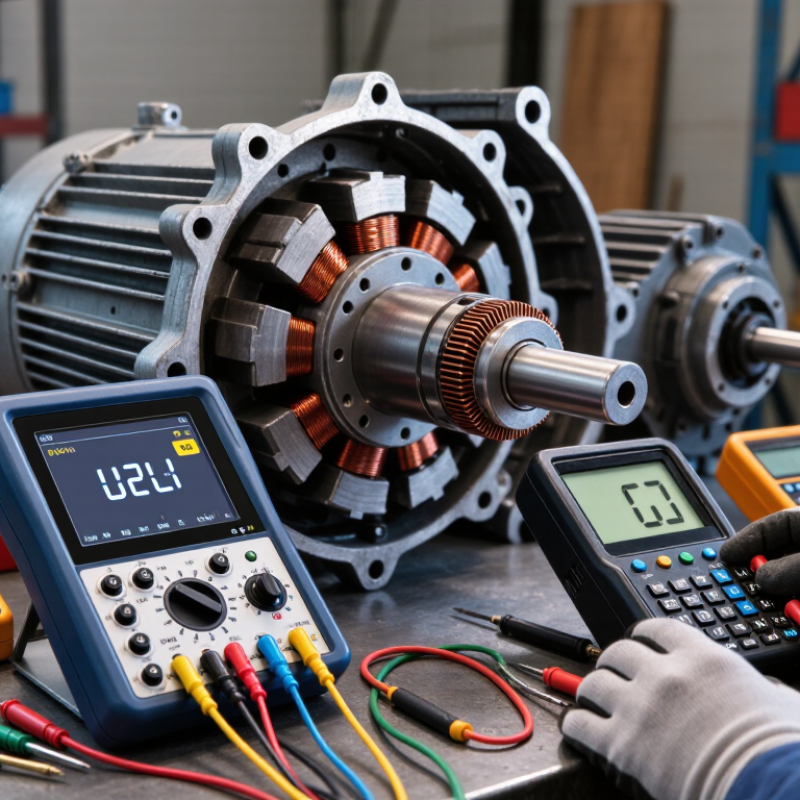
A stator tester should match the faults you need to find. It may measure winding resistance, insulation resistance, inductance, capacitance, and phase balance. Advanced instruments also apply a surge test. This reveals turn-to-turn weakness that ordinary resistance checks can miss. A technician might read three similar resistance values and still find a damaged winding. That is the uncomfortable part.
Resistance testing identifies loose connections and unequal copper paths. Insulation testing checks leakage between windings and the core. Surge testing stresses the winding briefly, helping expose weak enamel insulation.
Inductance comparisons can reveal shorted turns or assembly errors. Each result needs context. Temperature, lead length, moisture, and test voltage can change readings. IEEE 43-2013 provides guidance for insulation resistance testing, while IEC 60034-27-1 addresses off-line partial discharge measurements.
The scale of the risk makes these measurements practical, not decorative. The International Energy Agency estimates that electric motor-driven systems use 43% to 46% of global electricity. Its report, Energy-Efficiency Policy Opportunities for Electric Motor-Driven Systems, links better maintenance with efficiency opportunities. The U.S. Department of Energy also identifies motor systems as major industrial electricity users. Choose a tester with traceable calibration, repeatable test records, and suitable voltage ranges. A bright display is not enough. I would also verify whether the instrument supports automatic temperature correction and phase comparison. A perfect-looking report can still mislead when the operator skips grounding, records no temperature, or tests only one phase.
Choosing the best stator tester starts with the failure you need to detect.
A reliable device should measure insulation resistance, polarization index, winding resistance, and surge response. IEEE 43-2013 provides guidance for insulation-resistance and polarization-index testing. IEC 60034-27-1 covers offline partial-discharge measurement. These references help turn a feature list into a practical inspection plan. Look for stable readings, adjustable test voltage, and clear pass-fail limits. A bright screen matters in a noisy workshop. So does saving results with the motor’s serial number.
Accuracy is only useful when the test is repeatable.
Compare voltage control, measurement resolution, lead compensation, and calibration records. A tester should identify open coils, shorted turns, poor connections, and moisture-related insulation weakness. Some instruments offer surge testing in the kilovolt range, but higher voltage is not automatically better. The correct level depends on the winding design and applicable procedure. The U.S. Department of Energy’s motor-system assessments show that motor-driven equipment represents a major share of industrial electricity use. Small diagnostic errors can therefore become expensive operating problems. I have found that complicated menus slow technicians down, although simple interfaces can hide important settings.
Tips:
Test the same motor when cold and warm, if possible. Keep the leads clean and firmly connected. Ask for a traceable calibration certificate, exportable reports, and service support. Do not trust a single number. Compare phase balance, temperature, previous records, and visual evidence. A tester may pass a winding today and still miss a developing fault. That limitation deserves honest attention.
How to Choose the Best Stator Tester for Your Needs?
How to Match Tester Capabilities to Your Application
The right stator tester should reflect your winding process, not merely its specification sheet. Begin with the faults you need to detect. Resistance testing can reveal loose connections or uneven winding lengths. Surge testing may expose weak insulation between turns. High-potential testing checks insulation strength, while inductance measurements can identify phase imbalance.
For a repair workshop, a compact tester with guided connections, clear readings, and automatic result storage may be enough. Technicians often test motors with different voltages and winding layouts. Flexible settings matter here. On a production line, testing speed and repeatability become more important. Look for automatic sequencing, fixture compatibility, barcode input, and pass-fail control. Every extra manual step can create another error.
In development work, deeper measurement control is usually valuable. Adjustable test parameters, waveform viewing, temperature compensation, and exportable data help engineers study borderline results. The test voltage, duration, and limits should match the motor design. Higher power is not automatically better.
It can be misleading.
A tester with ten functions may still lack the connection method your stator requires. I have seen teams focus on measurement range while overlooking fixture pressure and lead resistance. That choice produced inconsistent readings. Check calibration records, operator training, service access, and software usability before purchasing. A short trial with real stators can reveal more than a polished demonstration. The best match is the tester that produces dependable decisions during ordinary work, including the awkward cases.
| Tester Type | Primary Test Method | Typical Test Voltage or Signal | Key Measurements | Faults It Can Identify | Recommended Applications | Portability | Capability Level | Main Limitation |
|---|---|---|---|---|---|---|---|---|
| Low-Resistance Micro-Ohmmeter | Four-wire Kelvin resistance measurement | Low-voltage test current, commonly from 1 A to 100 A depending on the instrument | Winding resistance, phase-to-phase resistance, connection resistance, resistance imbalance | Loose connections, damaged conductors, poor joints, incorrect phase resistance and some shorted-turn conditions | Incoming inspection, repair verification, field maintenance and comparison of three-phase windings | Portable | High for resistance checks | Cannot independently confirm insulation strength or detect every turn-to-turn fault |
| Insulation Resistance Tester | DC insulation-resistance test between windings and ground | Common ranges include 250 V, 500 V, 1,000 V, 2,500 V and 5,000 V DC; selection depends on motor rating and procedure | Insulation resistance, polarization index and dielectric absorption ratio when supported | Moisture, contamination, aging insulation, leakage paths and insulation deterioration to ground | Routine maintenance of low- and medium-voltage motors, generators, transformers and cable-connected stators | Portable | High for ground-insulation assessment | DC testing does not provide the same information as an AC withstand or surge test and may not locate an exact turn fault |
| AC Hipot Tester | Applied AC withstand test with leakage-current monitoring | AC output selected according to the applicable standard, equipment rating and manufacturer procedure | Leakage current, breakdown or flashover, test duration and pass/fail status | Severe insulation weakness, breakdown risk between the winding system and ground, assembly defects and damaged insulation | Production-line safety testing, repaired motors and formal dielectric withstand verification | Usually bench or trolley mounted | High for dielectric withstand | Stressful test; incorrect voltage or duration can damage an already weakened winding, so procedures must be controlled |
| DC Surge Comparison Tester | Repetitive high-voltage impulse comparison of phase or coil waveforms | Impulse amplitude is selected according to winding design, insulation system and test procedure | Impulse waveform, waveform-area difference, phase comparison and pass/fail result | Turn-to-turn shorts, coil-to-coil insulation weakness, incorrect connections and certain winding assembly faults | Motor manufacturing, rewinding shops and quality control where early turn-insulation detection is required | Portable to bench mounted | High for turn insulation | Requires trained operators, suitable fixtures and carefully controlled test limits; unsuitable settings can stress the winding |
| Surge and Resistance Combination Tester | Integrated impulse, low-resistance and balance testing | Combines programmable impulse output with low-current or high-current resistance measurement | Surge waveform comparison, winding resistance, phase imbalance and stored test records | Turn insulation defects, winding resistance errors, poor joints, phase imbalance and selected connection faults | High-volume repair facilities, motor production lines and laboratories requiring several tests in one station | Bench mounted | Very high for multi-parameter testing | Higher purchase cost, more complex setup and greater training requirements than single-purpose testers |
| Motor Circuit Analysis Tester | Low-voltage electrical signature and impedance analysis | Low-energy test signals; exact frequency and signal level vary by instrument and test mode | Impedance, phase angle, inductance, resistance balance and selected frequency-response indicators | Some rotor-related effects, winding imbalance, connection problems, contamination and developing electrical abnormalities | Predictive maintenance, trend monitoring and testing motors without applying high-voltage stress | Portable | Medium to high for condition trending | Results depend strongly on baseline data, motor design and test interpretation; it is not a replacement for every withstand test |
| Three-Phase Winding Analyzer | Automated comparison of resistance, inductance, impedance and phase characteristics | Low-voltage measurement signals, with optional high-voltage modules on some systems | Phase-to-phase resistance, inductance, impedance, balance, frequency response and automated limits | Incorrect winding connections, open circuits, phase imbalance, poor joints and selected inter-turn abnormalities | Production testing, repair verification and repeatable quality inspection of three-phase stators | Portable or bench mounted | High for automated comparison | Requires correct winding configuration, reliable test fixtures and suitable reference limits for each motor design |
| Handheld Basic Stator Checker | Continuity, resistance, phase-sequence or basic insulation checks | Low-voltage continuity and resistance functions; insulation voltage depends on the selected model | Continuity, winding resistance, phase identification and basic pass/fail indications | Open circuits, gross resistance imbalance, incorrect phase identification and obvious connection faults | Service calls, troubleshooting, commissioning and quick screening before advanced testing | Highly portable | Basic | Limited fault discrimination, limited data storage and insufficient coverage for detailed production or insulation diagnostics |
Choosing the best stator tester begins with safety, not the display or price. The unit should have insulated test leads, guarded terminals, overload protection, and a clearly marked emergency stop. A stable enclosure also matters when the tester sits beside a repair bench. Keep hands away from exposed contacts, even during low-voltage checks. That sounds obvious, yet rushed inspections often create the greatest risk.
Accuracy depends on more than a claimed measurement range. Look for repeatable readings, adjustable test limits, and a calibration record from a competent laboratory. The tester should detect winding resistance differences, insulation weaknesses, and possible phase imbalances without confusing normal variation with failure. In my experience, clean probes and firm connections improve results immediately. Dust on a terminal can change a reading. Small details matter. A digital result is not automatically a correct result.
Ease of use supports both safety and consistency. Choose a model with readable instructions, simple controls, and automatic discharge after insulation testing. A technician should understand the result without searching through a dense manual. Data storage can help compare repairs over time, but it may also encourage blind trust in historical numbers. I once accepted a stable reading before checking a loose lead; the test had to be repeated. That mistake was avoidable. Training, maintenance, and sensible verification remain essential, even with a modern tester.
How to Choose the Best Stator Tester for Your Needs?
Cost is more than the purchase price. Estimate probes, fixtures, calibration, software, training, and possible repairs. A low-priced tester may become expensive when replacement sensors are difficult to obtain. I once overlooked fixture costs during a workshop upgrade. That mistake distorted the entire budget. Request a written ownership estimate for three to five years. Include downtime and operator learning time. Small details matter.
Support often determines whether a tester remains useful. Ask how quickly technical questions receive answers. Check whether manuals include wiring examples, fault codes, and maintenance intervals. Reliable support should offer practical diagnosis, not only scripted replies. Speak with current users if possible. Their experience may reveal delays that sales materials never mention. Test the support channel before purchasing. Send a specific question and measure the response.
Long-term value depends on stable measurements and adaptable design. Look for repeatable readings across different operators and temperatures. Confirm that test records can be exported in common formats. Ask whether calibration services remain available after several years. Modular fixtures can reduce future replacement costs. However, flexibility is not always valuable. Extra functions may increase training time and create more opportunities for setup errors. I still prefer a simpler tester when its core measurements are dependable. No scorecard is perfect. Review your priorities every year, because production needs can change.
A practical comparison of cost, support, and long-term value across common stator tester categories.
Scores are normalized from 0 to 100. Cost reflects purchase affordability, support reflects documentation, serviceability, and training access, while long-term value considers upgrade potential, repeatability, automation, and expected usefulness over the equipment lifecycle. The weighted fit score uses Cost 35%, Support 25%, and Long-Term Value 40%.
This is an example of a widget area that you can place text to describe a product or service. You can also use other WordPress widgets such as recent posts, recent comments, a tag cloud or more.
© 2025 International Fluid Power, Inc. All Right Reserved.