International Fluid Power Inc.
International Fluid Power - Innovative Partners For Global Sourcing Of Fluid Power Products. Your Complete Hydraulic Source in SE Minnesota.
Choosing a ptfe butterfly valve in 2026 requires more than comparing prices and catalog photographs. Industrial valve market forecasts show steady growth, although estimates vary by scope and region. Grand View Research projected the global industrial valves market to expand at about 4.8% annually from 2023 to 2030. MarketsandMarkets also identified process industries, water treatment, and energy infrastructure as major demand areas. These figures suggest opportunity, but they do not identify the correct valve for a specific pipeline.
Application details matter more than market size. Confirm the medium, concentration, temperature, pressure, flow direction, and operating frequency. PTFE offers strong chemical resistance, yet its pressure capability can decline near its temperature limit. A valve exposed to hot caustic cleaning fluid may need different materials than one handling chilled demineralized water. Check the manufacturer’s pressure-temperature chart, not just the nominal pressure class. This small step prevents expensive assumptions.
Reliable selection should also reference recognized standards. API 609 covers butterfly valve design and testing, while ISO 5211 addresses actuator mounting dimensions. ISO 5752 can help verify face-to-face dimensions for installation planning. These standards improve comparison, but certification alone does not guarantee service life. The uncomfortable truth is that a technically compliant valve can still fail when cycling, seat stress, or particle contamination is ignored. I would request test records, elastomer details, torque data, and traceable material certificates. Field experience matters. A clean specification today may still need revision after real operating conditions are observed. This guide examines those decisions with practical caution, professional evidence, and a clear focus on safe, maintainable valve selection.
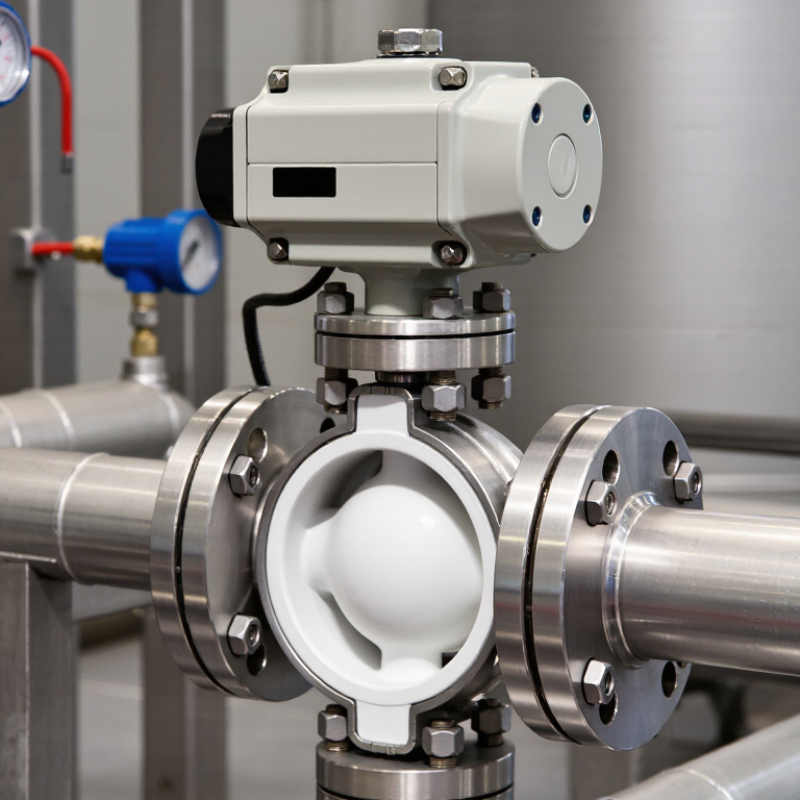
A PTFE butterfly valve uses a polytetrafluoroethylene seat or liner to control fluid flow. PTFE is valued for its chemical resistance and smooth sealing surface. The valve body holds a circular disc between two pipe sections. A stem turns the disc around a quarter turn. The disc opens, throttles, or blocks the passage. It works quickly.
When the handle or actuator rotates the stem, the disc changes position inside the flow path. In the open position, the disc aligns with the pipe and creates limited resistance. In the closed position, the disc presses against the PTFE seat. This contact forms the seal. Proper alignment matters. A scratched disc or uneven flange can cause leakage.
Choosing this valve requires more than checking the pipe diameter. Review the fluid, concentration, temperature, pressure, and flow speed. PTFE handles many aggressive chemicals, but it can deform under continuous heat or high compression. It also has limited resistance to abrasive particles. During maintenance reviews, technicians often find that incorrect bolt tightening damages the seat. That detail is easy to miss. Request pressure-temperature charts, torque requirements, leakage test records, and material certificates. Consider whether manual control is enough or an actuator is needed. A careful selection may still need revision after real operating data appears.
A PTFE butterfly valve uses a quarter-turn disc to regulate or isolate fluid flow. The PTFE liner provides low friction and broad chemical resistance. When selecting a valve, compare the liner’s temperature capability with the process temperature, while also checking pressure, media compatibility, disc material, and sealing requirements.
The chart shows typical upper continuous-use temperature references for common fluoropolymer materials. Actual butterfly-valve ratings depend on pressure, construction, service media, and the manufacturer’s design.
2026 How to Choose a PTFE Butterfly Valve?
PTFE-lined butterfly valves suit corrosive aqueous fluids, acids, alkalis, salts, and many solvents. They also perform well with demineralized water and high-purity process liquids. However, chemical resistance is never universal. Fluid concentration, temperature, pressure, and exposure time can change the result. A valve handling 20% acid may face different stress at 80°C. Check the actual operating range, not only the fluid name.
PTFE handles many demanding services, but it has limits. High temperature can increase creep and reduce sealing stability. Sudden cooling may create stress between the liner and valve body. Some gases and solvents can permeate PTFE, especially under pressure. Vacuum service needs extra review. The disc, stem, seat, and nearby gaskets must also match the fluid. Choosing only by liner material is a common mistake. I have seen apparently suitable valves fail because pressure cycling was ignored.
Tips: Provide the supplier with fluid concentration, minimum and maximum temperature, pressure, flow speed, and cycling frequency. Ask for compatibility data at those exact conditions. Inspect the liner after installation and during planned maintenance. Do not rely on a general chemical chart alone. Small details matter. If the fluid contains abrasive particles, expect faster wear near the disc edge. A trial installation may be wiser than an assumption.
Use this comparison as a preliminary selection guide. PTFE provides broad chemical resistance, but the final choice must also consider temperature, pressure, concentration, permeation, valve construction, cycling frequency, and the specific PTFE grade.
| Fluid or Service | PTFE Compatibility | Typical Suitable Conditions | Why PTFE May Be Selected | Main Limitations and Risks | Selection Guidance |
|---|---|---|---|---|---|
| Water and Demineralized Water | Generally Suitable | Ambient to moderate temperatures; clean or mildly contaminated water. | Low friction, good corrosion resistance, and low water absorption. | Hot water service can accelerate creep and seat wear; pressure and temperature derating may apply. | Suitable for general water isolation when the valve pressure-temperature rating is adequate. |
| Dilute and Concentrated Acids | Often Suitable | Many inorganic and organic acids at temperatures within the liner rating. | PTFE is highly resistant to many corrosive acids and does not rely on a protective oxide layer. | Strong oxidizing acids, high temperature, concentration changes, and impurities can alter compatibility. | Confirm the exact acid concentration, temperature, pressure, and exposure time using a chemical compatibility review. |
| Alkalis and Caustic Solutions | Generally Suitable | Most aqueous alkaline services within the recommended operating envelope. | Very good resistance to sodium hydroxide, potassium hydroxide, and many alkaline cleaning fluids. | High temperature may increase liner deformation; abrasive crystals or deposits may damage sealing surfaces. | Check concentration, operating temperature, seat stress, and the risk of solids accumulating around the disc. |
| Chlorine-Containing Chemicals | Conditionally Suitable | Selected wet chlorine or hypochlorite services at controlled temperature and concentration. | PTFE offers strong resistance to many aqueous halogenated chemicals. | Dry chlorine, strong oxidizing conditions, elevated temperature, and permeation can create significant design risks. | Verify whether the service is wet or dry and review the complete valve, stem, disc, and elastomer material combination. |
| Organic Solvents | Case-by-Case | Many solvents are acceptable at moderate temperature, but compatibility is chemical-specific. | PTFE has low swelling and good resistance to a wide range of hydrocarbons and solvents. | Some solvents can permeate PTFE, affect nearby elastomers, or create fugitive-emission concerns. | Check solvent type, vapor pressure, temperature, permeability, and the valve’s emissions requirements. |
| Oils, Fuels, and Hydrocarbons | Usually Suitable | Liquid hydrocarbon service within the pressure, temperature, and fire-safety requirements. | Low friction and broad chemical resistance to many petroleum-based fluids. | PTFE is not inherently fire-safe; permeation, rapid gas decompression, and elastomer compatibility require review. | For combustible service, specify an appropriate fire-tested design and compatible secondary sealing materials. |
| Steam and Hot Condensate | Usually Not Preferred | Only limited low-temperature or intermittent steam service if specifically approved by the valve design. | PTFE retains useful chemical resistance, but chemical resistance alone does not ensure steam suitability. | High temperature, creep, deformation, thermal cycling, and pressure-temperature derating can shorten service life. | Use a steam-rated seat and valve design; do not select a standard PTFE-lined butterfly valve solely from chemical compatibility data. |
| Compressed Air and Inert Gas | Conditionally Suitable | Clean, dry air or inert gas within the valve’s gas-pressure rating. | Low friction and low moisture absorption can support reliable operation. | Gas permeation, rapid decompression, adiabatic heating, and seat leakage may be important at high pressure. | Confirm gas-service approval, pressure class, decompression resistance, and required leakage rate. |
| High-Purity and Pharmaceutical Fluids | Suitable with Hygienic Design | Clean liquids and chemicals where the PTFE grade and surface finish meet process requirements. | Low reactivity, low absorption, and good cleanability. | Standard industrial butterfly valves may have dead spaces, unsuitable lubricants, or non-compliant elastomers. | Specify sanitary construction, surface finish, clean-in-place requirements, extractables limits, and documentation. |
| Abrasive Slurries and Suspensions | Limited Suitability | Low-solids or mildly abrasive slurries at moderate flow velocity. | PTFE can resist chemical attack from the liquid carrier. | Particles can erode the liner, scratch sealing surfaces, and increase operating torque. | For high-solids or highly abrasive service, consider a dedicated slurry valve and verify particle size and velocity. |
| Dry Powder and Granular Solids | Generally Unsuitable | Only specially engineered applications with controlled particle loading. | PTFE may reduce friction in certain low-load applications. | Particles can become trapped at the seat, cause abrasion, prevent tight shutoff, and increase torque. | Choose a valve designed specifically for dry solids, powder flow, and the required sealing duty. |
Material selection begins with the fluid, temperature, and pressure. Virgin PTFE offers broad chemical resistance and commonly lists a maximum service temperature near 260°C. However, lined butterfly valves often receive lower limits, typically 150–200°C, because the body, stem, and seat become limiting parts. Check the complete pressure-temperature table, not the PTFE data alone. ASME B16.34 requires pressure ratings to reflect temperature effects. Ratings can fall sharply as heat rises.
Design changes installation performance. Wafer valves save space between flanges, while lug designs support easier pipe-side maintenance. Double-flanged bodies suit heavier pipelines. Concentric designs usually provide lower cost and simpler operation. Double-eccentric designs reduce seat rubbing, but they may need more careful alignment.
MSS SP-67 and ISO 5752 provide useful dimensional and valve-type references. The 2024 Global Industrial Valves Market report by Fortune Business Insights projects continued market growth through 2032, reflecting wider demand for reliable flow control across chemical and water systems.
In field inspections, a stainless-steel stem often resists corrosion better than carbon steel. Ductile iron reduces cost, while stainless bodies suit aggressive surroundings. Still, a stronger body cannot correct an incompatible liner. I have seen specifications fail by naming “PTFE” without defining grade, reinforcement, permeability, or cycle count. That is a weak specification. Ask for seat leakage testing, actuator torque data, and pressure tests under ISO 5208. Small details matter.
2026 How to Choose a PTFE Butterfly Valve?
Choosing the correct size starts with flow, not pipe diameter alone. Calculate the required flow rate, pressure drop, media temperature, and operating pressure. A valve that is too large may operate near its seat, causing unstable control and unnecessary wear. A valve that is too small can create excessive velocity and pressure loss. Check the PTFE temperature rating carefully, especially with hot chemicals. Small details matter.
Actuator selection depends on torque, cycle frequency, and operating conditions. Add a practical safety margin to the calculated torque, because dry service, deposits, or temperature changes can increase resistance. Pneumatic actuators suit frequent cycling and fast isolation. Electric actuators fit sites without instrument air, but power failure behavior needs careful planning. Manual operation may work for smaller valves. Not always.
The connection type must match the pipeline layout and maintenance plan. Wafer valves are compact and often economical between flanges. Lug-style connections allow more flexible removal and may support dead-end service when properly rated. Flanged designs can simplify alignment in larger systems, but they need sufficient installation space. Confirm flange standards, bolt dimensions, face-to-face length, and gasket compatibility before ordering. Do not rely on nominal size alone. Review the valve data sheet, piping drawings, and applicable standards with a qualified engineer, then verify performance through inspection or testing.
How to Choose a PTFE Butterfly Valve in 2026?
Installation begins with chemical compatibility, not appearance. PTFE handles many corrosive fluids, but temperature, pressure, and concentration still matter. Many PTFE-lined designs are rated near 260°C, although continuous limits vary by grade and pressure. Confirm the supplier’s tested values before selection. API 609 provides dimensional and performance guidance for butterfly valves, while ISO 5208 defines pressure-test leakage criteria. These standards create a safer baseline than catalogue claims alone.
Keep the pipeline clean and aligned. Even small weld beads can damage the liner during operation. Install the valve with the disc slightly open, then tighten bolts in a cross pattern. Do not use the valve to correct pipe misalignment. It is a common shortcut, and it often increases operating torque. After installation, test for seat leakage under the specified pressure. ISO 15848-1 also offers a recognized framework for fugitive-emission testing, which is valuable in chemical service.
Maintenance should include monthly visual checks, actuator response, flange seepage, and unusual noise. Record torque changes, not just failures. A rising torque trend may indicate deposits, liner deformation, or poor alignment. Before inspection, isolate, depressurize, drain, and lock out the line. OSHA’s control-of-hazardous-energy data emphasizes documented isolation procedures for servicing equipment. Do not trust a closed valve as the only barrier. I would also recheck the maintenance interval after the first operating season; real fluid conditions often expose assumptions made during selection.
This is an example of a widget area that you can place text to describe a product or service. You can also use other WordPress widgets such as recent posts, recent comments, a tag cloud or more.
© 2025 International Fluid Power, Inc. All Right Reserved.