INTERNATIONAL FLUID POWER, INC.

The Experts for Hydraulic Power Units, Components, and Custom Hydraulic Systems
Slider

7 Tips for Buying Marine Steel Pipes Globally

Buying Marine Steel Pipes across borders demands more than comparing prices on a supplier’s webpage. These pipes may face saltwater, vibration, pressure, and long periods of storage. A small error in wall thickness can become an expensive problem at the installation site. This guide introduces seven practical tips for evaluating mills, specifications, certificates, inspections, logistics, and after-sales support. Marine Steel Pipes should match the vessel’s design requirements, operating environment, and approved engineering standards.

Real purchasing experience shows that documentation deserves the same attention as physical quality. Review mill test certificates, heat numbers, chemical composition, mechanical results, coating details, and traceability records. Ask how each pipe is tested before shipment. Photographs of bundled pipes, stamped markings, end protection, and loading conditions can reveal useful details. Still, photographs are not proof of everything. Independent inspection may be worthwhile when order values are high or delivery schedules are tight.

International procurement also requires careful communication. Confirm dimensions in writing, including outside diameter, length tolerance, bevel type, and coating system. Clarify packaging, port responsibilities, insurance, and delivery terms before signing. A low quotation may exclude testing, export documents, or inland transport. That surprise is avoidable. Even experienced buyers occasionally overlook time-zone delays or translation differences. No checklist is flawless. Careful questions, realistic lead times, and verifiable supplier records create a stronger buying decision. The goal is not merely to purchase steel, but to secure dependable performance at sea.
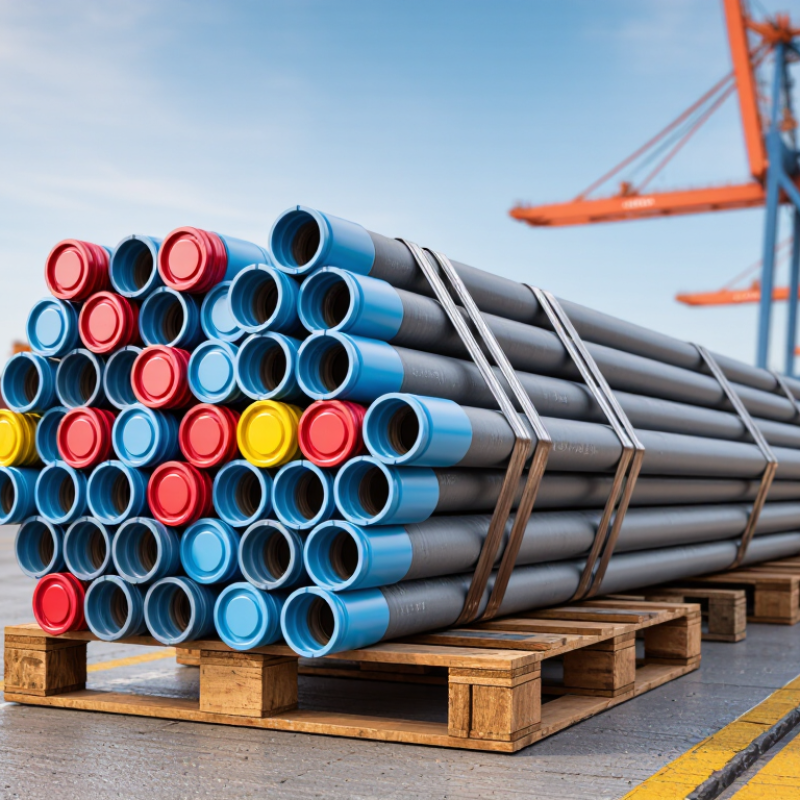
7 Tips for Buying Marine Steel Pipes Globally

Define the Marine Steel Pipe Requirements for Your Project

When buying marine steel pipes globally, define the project requirements before comparing prices. Start with service conditions, not a supplier’s catalog. Record the working pressure, temperature range, seawater exposure, flow rate, and installation depth. Include outside diameter, wall thickness, pipe length, and connection method. Small omissions can create expensive changes later.

Choose the steel grade according to strength, toughness, weldability, and corrosion risk. Clarify whether the pipes need internal lining, external coating, or cathodic protection. For offshore use, specify impact testing at the design temperature. Ask for heat numbers, mill certificates, dimensional reports, and non-destructive testing records. Independent inspection may be appropriate for critical pipelines.

Match the purchase specification with the project’s governing codes and classification requirements. Requirements can differ between shipbuilding, offshore structures, seawater intake systems, and port facilities. Check allowable tolerances carefully. A pipe may meet its nominal size but still fail during fitting. I have seen projects focus heavily on grade while overlooking flange alignment and transport damage. That was a costly lesson. Define packing, lifting points, marking, storage limits, and delivery documents before production begins. Also confirm whether the proposed material is acceptable in the destination country and under the project contract.

7 Tips for Buying Marine Steel Pipes Globally - Define the Marine Steel Pipe Requirements for Your Project

Tip Requirement Dimension Recommended Project Definition Typical Data or Range Why It Matters
1 Identify the service environment State whether the pipe will be used for seawater, ballast water, cooling water, dredging, structural piling, cargo transfer, or another marine application. Seawater exposure; splash-zone service; submerged service; internal pressure; external hydrostatic pressure; cyclic loading. Saltwater, immersion, pressure, and wave-induced loads can require different steel grades, wall thicknesses, coatings, and inspection levels.
2 Select the material and grade Specify the applicable standard and minimum mechanical properties instead of requesting only “marine steel pipe.” Common carbon-steel yield-strength classes include approximately 235 MPa, 275 MPa, and 355 MPa; higher-strength grades may be specified for weight-sensitive structures. The grade affects strength, weldability, impact performance, weight, and acceptance by the project’s classification or regulatory requirements.
3 Define dimensions and design pressure Provide outside diameter or nominal bore, wall thickness, pipe length, end preparation, and design pressure or load cases. Outside diameters commonly range from about 114 mm to over 1,000 mm; wall thickness is often approximately 6–25 mm, subject to design calculations. Incorrect dimensions can cause excessive stress, buckling, flow loss, welding problems, or incompatibility with flanges and fittings.
4 Choose the manufacturing method Specify seamless, longitudinally welded, or spiral-welded pipe according to diameter, pressure, availability, and project standards. Seamless pipe is often used for smaller diameters or demanding pressure service; welded pipe is commonly practical for larger diameters and long marine sections. The production route influences dimensional range, weld inspection requirements, lead time, cost, and traceability.
5 Set corrosion-protection requirements Define internal and external coating systems, surface preparation, coating thickness, holiday testing, and any required corrosion allowance. Typical external coating thickness may range from approximately 250–500 μm for multi-layer protective systems; the final value depends on exposure and coating specification. Marine atmospheres and seawater accelerate corrosion, especially at welds, joints, splash zones, and damaged coating areas.
6 Specify testing and inspection List required chemical analysis, tensile testing, bend testing, hydrostatic testing, weld examination, dimensional inspection, and impact testing where applicable. Non-destructive examination may include ultrasonic, radiographic, magnetic-particle, or dye-penetrant testing; the extent should be stated as a percentage or acceptance class. Clear inspection criteria reduce disputes and verify that the pipe is suitable for pressure, structural, and fatigue-related service.
7 Control documentation and global delivery Request heat-number traceability, material certificates, inspection reports, coating records, packing details, and shipping dimensions before placing the order. Use mill test certificates with chemical and mechanical results, a packing list, certificate of conformity, and agreed delivery terms and port documentation. Complete records support customs clearance, quality audits, installation approval, future maintenance, and traceability of every pipe batch.
Minimum purchase specification: Application and environment; applicable standard; steel grade; outside diameter or nominal bore; wall thickness; pipe length; end preparation; coating system; testing scope; certification level; packing method; quantity; delivery port; and required delivery date.

Verify Steel Grades, Standards, and Marine Certifications

7 Tips for Buying Marine Steel Pipes Globally

Verify Steel Grades, Standards, and Marine Certifications

Buying marine steel pipes globally starts with the steel grade. Match the grade to the vessel’s structure, temperature range, welding method, and service load. World Steel Association’s World Steel in Figures 2024 reported 1,888 million tonnes of crude steel production in 2023. This scale creates choice, but also creates traceability risks. Do not guess.

Request the original mill test certificate for every heat number. Check chemical composition, yield strength, tensile strength, impact results, dimensions, and heat-treatment records. Then compare them with the specified marine standard, such as ship-class rules or recognized pressure-pipe standards. A certificate can look perfect and still hide a mismatch. I have learned that document review alone is not enough.

Confirm certification directly with the issuing classification society. IACS technical information indicates that its members cover more than 90% of global oceangoing cargo tonnage, making class verification highly significant. Ask for approval scope, certificate validity, product size range, and manufacturing location. Inspect pipe markings before shipment. Trace every heat. Use an independent inspector for sampling, ultrasonic testing, and coating checks. Record deviations, even small ones. A one-millimeter wall-thickness difference may affect welding fit-up and corrosion allowance. The uncomfortable part is simple: global suppliers may provide compliant documents, but not every document proves the exact pipe was tested.

Compare Pipe Dimensions, Coatings, and Corrosion Protection

7 Tips for Buying Marine Steel Pipes Globally

Compare dimensions before comparing prices. Confirm outside diameter, wall thickness, length, and weight tolerance. A pipe that looks suitable may fail when connected to existing marine systems. Request dimensional inspection records, not only a product drawing. Check whether measurements were taken before or after coating. This detail can change fit.

Coating selection deserves practical attention. Fusion-bonded coatings, epoxy systems, and metallic layers perform differently in seawater, splash zones, and buried sections. Ask for coating thickness, surface preparation, holiday testing, and repair procedures. Salt contamination can weaken adhesion. It is easy to overlook. Specify the intended exposure, temperature, and abrasion level. Then compare the coating’s tested performance under similar conditions. Do not accept vague claims about “excellent corrosion resistance.”

Corrosion protection should also include pipe chemistry, weld quality, end protection, and storage conditions. Request material certificates, traceability documents, and independent inspection when the project is critical. During shipping, damaged caps or trapped moisture can start rust before installation. Use sealed ends and inspect the surface on arrival. I once underestimated how quickly scratches expanded near a wet loading area. That mistake changed my inspection checklist. Cathodic protection may support the coating, but it cannot repair poor surface preparation. Compare delivery times, inspection scope, and replacement terms with equal care. The cheapest pipe may become expensive after rework, delays, and premature maintenance.

Assess Global Suppliers, Manufacturing Quality, and Traceability

Global marine steel pipe buying demands more than a low quotation. Supplier capacity, manufacturing discipline, and traceability deserve equal attention.

UNCTAD’s Review of Maritime Transport 2024 reports that the global commercial fleet exceeded 2.4 billion deadweight tons in early 2024. This scale increases demand for dependable pipe supply and consistent documentation. Assess each supplier’s production route, annual capacity, coating facilities, and export experience. Can they support your delivery window? Ask for recent project references, not only brochures. Verify whether outsourced processes are clearly disclosed.

Manufacturing quality begins with the specified steel grade and production method. Request mill certificates showing heat chemistry, tensile strength, impact results, dimensions, and inspection status. Check welding procedures, ultrasonic testing, hydrostatic testing, and coating thickness records. Independent inspectors should witness critical tests when project risk justifies the cost. The World Steel Association reported 1.89 billion tonnes of crude steel production in 2023. A huge upstream market does not guarantee uniform pipe quality.

Traceability should follow the heat number from billet or plate to finished pipe, coating, packing, and shipment. Compare physical markings with digital records and certificates. A polished document is not proof. In practice, one missing transfer record can weaken an otherwise strong inspection file. QR-based systems help, but they still need human verification. I would also challenge unclear tolerances and unexplained test substitutions. Small gaps become expensive offshore.

7 Tips for Buying Marine Steel Pipes Globally - Assess Global Suppliers, Manufacturing Quality, and Traceability

The chart compares the minimum specified yield strength of commonly referenced international pipe and offshore steel grades. Use the applicable standard, pipe thickness, design code, inspection certificate, heat number, and third-party verification to confirm that delivered material matches the purchase specification.

Review Pricing, Shipping Terms, Inspection, and Delivery Risks

7 Tips for Buying Marine Steel Pipes Globally

Tip 1: Compare landed cost, not only the mill quotation. Add steel price, testing, packing, insurance, duties, inland transport, and port charges. A low unit price can hide expensive handling. Tip 2: Request at least three comparable offers. Specify diameter, wall thickness, grade, length tolerance, coating, and quantity. Otherwise, price comparisons become misleading. Tip 3: Review payment stages carefully. A small deposit may protect cash flow, but delayed balance payments can affect production priority. That risk is easy to underestimate.

Tip 4: Clarify shipping terms in writing. Under Incoterms, confirm who controls freight, insurance, export clearance, and unloading. Tip 5: Build a delivery buffer. UNCTAD’s Review of Maritime Transport 2024 reported 2.4% maritime trade growth in 2023 and forecast 2.1% growth for 2024. More cargo can increase congestion pressure. Rerouting, weather, and port delays may still disrupt schedules. A two-week buffer is sensible for critical projects, though not always sufficient. Tip 6: Use independent inspection before shipment. Check chemical composition, tensile results, hydrostatic testing, dimensions, markings, and coating thickness. Request traceable mill certificates and photographic records. EN 10204 inspection documents can support accountability, but paperwork alone does not prove pipe quality. Inspectors must match the purchase specification.

Tip 7: Create a delivery-risk register. Record the supplier’s production date, vessel window, transshipment points, document deadlines, and backup transport options. The World Bank’s Commodity Markets Outlook shows how commodity prices can remain volatile during geopolitical and supply disruptions. Marine pipe budgets need contingency funds. I would also review the plan after every shipment. Some assumptions fail in practice. A perfect spreadsheet cannot remove port uncertainty.