International Fluid Power Inc.
International Fluid Power - Innovative Partners For Global Sourcing Of Fluid Power Products. Your Complete Hydraulic Source in SE Minnesota.

China Top 10 Transformer Winding Machine Suppliers
Electricity networks are expanding, and transformer manufacturers face pressure to increase production without sacrificing precision. The International Energy Agency’s 2023 report, Electricity Grids and Secure Energy Transitions, says annual grid investment must exceed $600 billion by 2030. It also estimates that 80 million kilometres of grids may need to be added or refurbished by 2040. These figures point to sustained demand for reliable transformers and the equipment used to build them.
Transformer Winding machines shape conductor coils for distribution, power, and specialty transformers. Their capabilities affect winding accuracy, coil consistency, production speed, and material handling. On a factory floor, details matter: wire tension, turn counting, tooling changeovers, and the operator’s ability to inspect a finished coil. A faster machine is not automatically a better investment. Service support and process fit matter, too.
This guide introduces ten transformer winding machine suppliers and the factors buyers can compare, including machine types, automation options, production applications, and technical support. The IEA report describes grid investment, not machine-market size, so its figures should be read as industry context rather than direct sales forecasts. That distinction matters. Supplier claims also deserve careful checking against specifications, references, and actual production requirements. No ranking fits every factory. A small workshop may value flexible changeovers, while a high-volume plant may prioritize repeatability and throughput. The comparison is a starting point, not a substitute for technical evaluation.
Define Transformer Winding Machines and Their Role in IEC 60076 Manufacturing
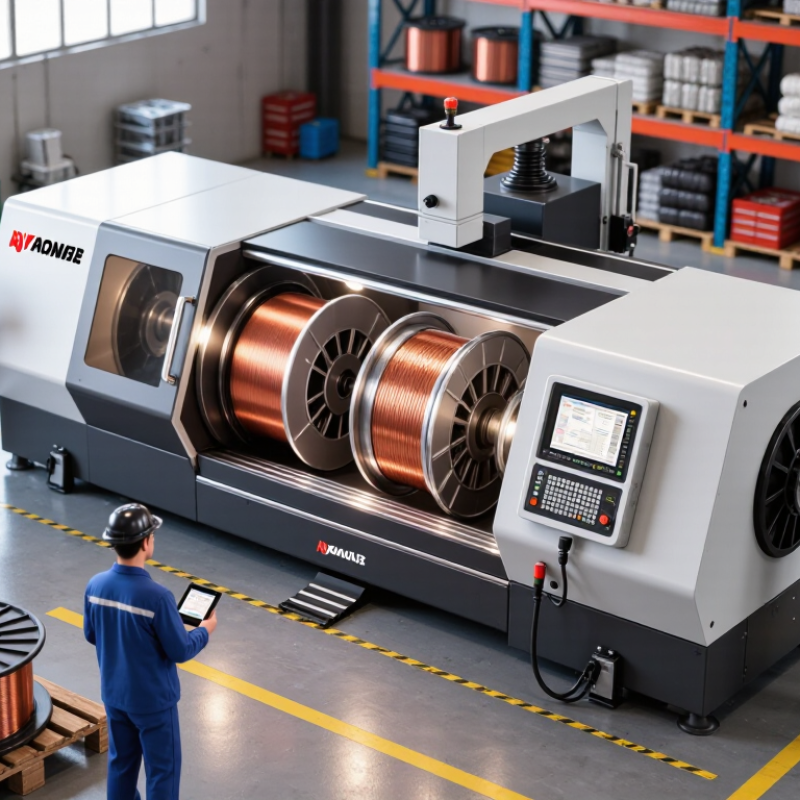
A transformer winding machine forms copper or aluminum conductors into controlled coils around a core limb or former. It manages rotation, conductor tension, traverse, and insulation placement. In a factory, operators set winding dimensions, turn counts, and lead positions from approved drawings. The machine does not decide the electrical design. It repeats it.
That repeatability matters in manufacturing to IEC 60076 requirements. The IEC 60076 series addresses transformer ratings, performance, and testing; it is not a winding-machine specification. Winding equipment helps manufacturers build coils that match design records and withstand later assembly and testing. For example, stable tension keeps a foil layer flat, while accurate traverse reduces uneven edges. Small shifts matter.
Operators still inspect conductor damage, insulation overlap, and winding height, then record settings and deviations. These checks support traceability, but machine data alone cannot prove a transformer meets every applicable requirement. That distinction is easy to overlook. A practical line balances automation with skilled review, especially when conductor size or insulation thickness changes. No winding process is flawless; even a neat coil deserves careful verification before the next stage.
China Top 10 Transformer Winding Machine Suppliers - Define Transformer Winding Machines and Their Role in IEC 60076 Manufacturing
Anonymous, non-ranked overview of ten transformer-winding equipment capability areas associated with the supplier market. Entries describe machine categories and typical uses, not verified profiles of individual suppliers.
| No. | Equipment Capability Area | Typical Winding Work | Common Transformer Application | Manufacturing Controls to Consider | Relationship to IEC 60076 | Useful Procurement Checks |
|---|---|---|---|---|---|---|
| 1 | HV layer-winding machines | Wind insulated round or rectangular conductors in successive layers, with controlled tension and spacing. | Layer-wound high-voltage coils for distribution and power transformers. | Conductor tension, turn count, insulation placement, winding direction, and repeatability. | Winding quality contributes to the designed insulation system and electrical performance. IEC 60076 does not specify a particular machine model. | Confirm supported conductor formats, tension-control method, recipe storage, and process-record options. |
| 2 | LV foil-winding machines | Wind wide conductive foil with interlayer insulation, often using automatic foil feeding and edge alignment. | Low-voltage windings in distribution transformers and other foil-wound designs. | Foil tracking, tension, insulation-paper alignment, weld quality where applicable, and end-turn formation. | Consistent winding supports the transformer design and its verification; IEC 60076 requirements apply to the transformer, not to a named winding-machine category. | Check foil-width range, material handling, edge-guiding accuracy, and compatibility with the specified insulation materials. |
| 3 | HV disc-winding machines | Form coils as a sequence of discs, with conductor turns arranged and connected according to the winding design. | Disc-wound windings commonly used in power-transformer designs. | Disc geometry, turn placement, conductor tension, transposition steps, and lead positioning. | The finished winding must meet the design and applicable transformer requirements; IEC 60076 includes transformer performance and test requirements. | Review whether the machine supports the required disc sequence, conductor type, winding dimensions, and process documentation. |
| 4 | Continuous-disc winding systems | Produce connected disc sections using a continuous winding process and specified conductor transpositions. | Continuous-disc windings for suitable power-transformer designs. | Transposition accuracy, conductor routing, insulation handling, and consistency between sections. | Manufacturing accuracy helps realize the designed winding arrangement; IEC 60076 does not prescribe the winding sequence or machine configuration. | Ask for demonstrations using representative conductors and review how transpositions and winding data are recorded. |
| 5 | Automatic wire-winding machines | Wind round wire or smaller conductors using programmed turns, speed, direction, and tension settings. | Small and medium coils, control windings, and suitable distribution-transformer components. | Turn counting, wire tension, start-and-finish lead location, and protection of conductor insulation. | Supports repeatable manufacture of transformer components; IEC 60076 compliance is established through the transformer design, construction, and applicable tests. | Check wire-size compatibility, winding accuracy, safety interlocks, and ease of changing validated recipes. |
| 6 | Sectional and multi-section winding machines | Wind coils in separated sections with controlled spacing and insulation barriers. | Transformer designs requiring sectionalized windings or defined insulation clearances. | Section dimensions, spacing, insulation-barrier placement, and lead routing. | Insulation design and dielectric verification are addressed at transformer level; IEC 60076-3 covers insulation levels and dielectric tests. | Verify section-count flexibility, tooling options, dimensional repeatability, and alignment with the approved winding drawings. |
| 7 | CNC horizontal coil-winding systems | Wind larger coils on horizontal machines with programmable rotation, traverse, and process parameters. | Large transformer coils and production environments requiring repeatable programmed operations. | Spindle alignment, winding tension, traverse accuracy, safe handling, and traceable production settings. | Provides manufacturing process control but does not itself establish IEC 60076 conformity or replace required transformer tests. | Assess workpiece capacity, control-system support, operator training needs, guarding, and maintenance arrangements. |
| 8 | Vertical winding machines | Wind coils with the workpiece oriented vertically, often where coil size or handling needs favor this arrangement. | Large or heavy coils for power-transformer production, subject to the design and machine capacity. | Workpiece stability, conductor tension, lifting and clamping safety, and dimensional control. | Machine orientation is a manufacturing choice; the completed transformer remains subject to applicable IEC 60076 requirements and tests. | Confirm safe load capacity, floor and foundation needs, coil-size envelope, and integration with lifting equipment. |
| 9 | Foil-and-wire combination winding systems | Handle foil, wire, or coordinated conductor operations where a winding design calls for different conductor forms. | Specialized transformer coils and production lines with varied winding designs. | Changeover control, material-specific tension settings, insulation alignment, and recipe management. | Supports production flexibility; IEC 60076 does not define a universal combination-machine specification. | Request a process trial with the intended materials and verify changeover time, tooling, and data-retention features. |
| 10 | Integrated coil-winding production lines | Combine winding with selected feeding, insulation handling, coil transfer, or production-data functions. | Factories seeking coordinated production for multiple transformer coil types. | Process handoffs, traceability, line balancing, quality checkpoints, and operator safety. | Integration can support manufacturing consistency, but IEC 60076 conformity is determined for the finished transformer through applicable design and verification activities. | Review interface compatibility, service support, spare parts, data export, commissioning scope, and acceptance criteria. |
Note: IEC 60076 is a series of standards for power transformers. It does not certify winding machines or prescribe a universal winding-machine specification. Applicable requirements depend on the transformer type, design, and relevant parts of the standard.